Passport for the Wandering Ferry
Page 169 of 230
Chapters
“Not yet. I’m in the pocket.” Quinn looked at the shore marks, then down at the water beside the hull. The ferry’s forward movement dwindled to almost nothing. They could feel the engine idling through the deck, but the bow no longer pressed on.
A pause was not failure. That had been harder to learn than any repair: stopping could be a skilled action, an intentional part of the route. Quinn let their shoulders drop. The hull settled, the current loosened its hold, and the stern came to rest with a small gap between it and the reed shelf.
Quinn’s eyes stayed on that gap. They were not going to make the turn by pretending it was larger.
“I’m stopped,” Quinn told Mara. “The stern’s clear. I’m letting it settle before I finish.”
“Good. I’m still outside. Take the time you measured for.”
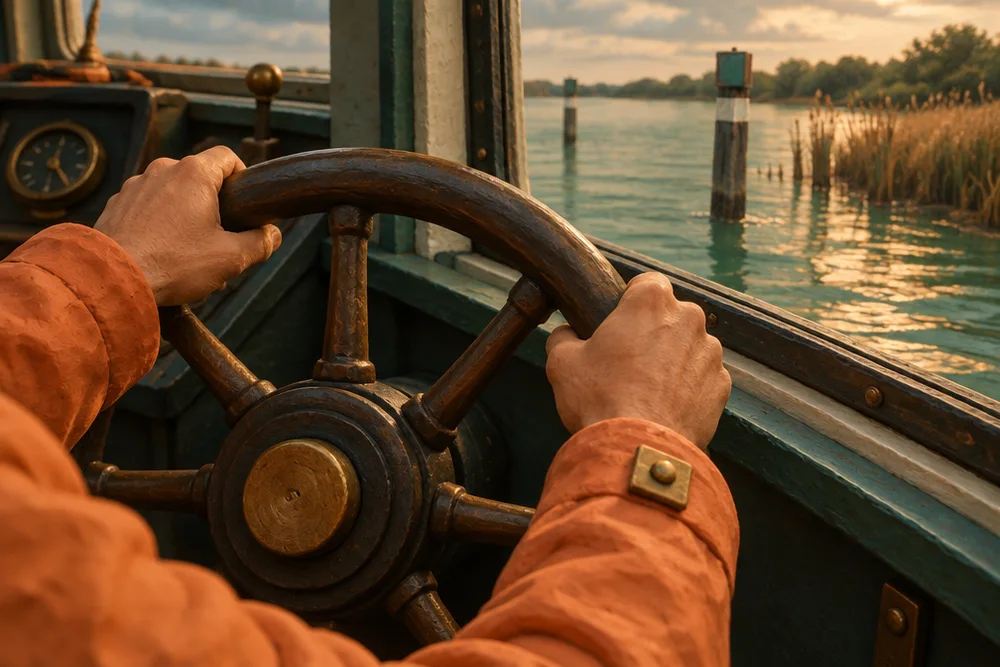
Quinn listened to the idle. The replacement drive had been cleared after the mount was changed, but the earlier knock remained in memory, sharp as a tool dropped in a quiet shed. They watched the wheelhouse instruments, then looked through the side window at the waterline. The ferry was level. The drive’s pitch did not waver.
A reed head bobbed in the small current beside the stern. It had not been struck or folded. The bank beyond it carried hoof cuts from animals coming to the seep, and the exposed mud bore their old prints. Quinn pictured those marks under a fence line that blocked the commonage approach. A boundary drawn wrong could do damage without a boat ever touching the bank.
They had no wish to turn this run into proof that the ferry could go anywhere. The measurements had given them one small passage with conditions: sufficient water, marked alignment, a low speed, a known pocket and a person watching the exit. Those conditions were not obstacles to be overcome. They were what made the route possible.
The hull nudged once against the easing current. Quinn waited until it stopped. Then they gave the wheel a measured adjustment and brought the throttle forward just enough to move the bow into the next line. The stern stayed in the pocket for another breath, then began to follow.
Quinn did not chase it with a sudden turn. They held their hands steady, eyes shifting between the far mark and the reeds. The space opened by inches. Water slid past the hull without a slap. When the stern finally aligned behind the bow, Quinn let out the breath they had been holding.