Orchard of the Drifting Boats
Page 100 of 231
Chapters
“If they let go, they lose it,” said one of the growers behind her.
“They’ve already lost the lane,” Orla replied. “They need to get themselves back first.”
The words sounded harsher than she intended. No one answered. The river made the decision plain enough.
A scrape carried across the water. The soil box had lodged against a submerged post, and the scow behind it swung into the current. Its trunk grazed the surface, shedding leaves. The punt’s trailing line snagged on the box corner; Joss cut it loose with a knife.
The freed rope slapped the water. Joss raised an arm, but the punt had begun to drift downstream, pulled sideways by the current. Pellin turned the bow with both oars. For a moment they looked as if they might clear the row. Then the scow they had first caught rolled back into their path, its empty hull rising and falling like a door on a hinge.
Tallis watched the angle. “They’ll have to leave the punt.”
“They can’t leave it in the lane,” said the grower behind Orla.
“The lane’s gone,” Tallis said. “Look.”
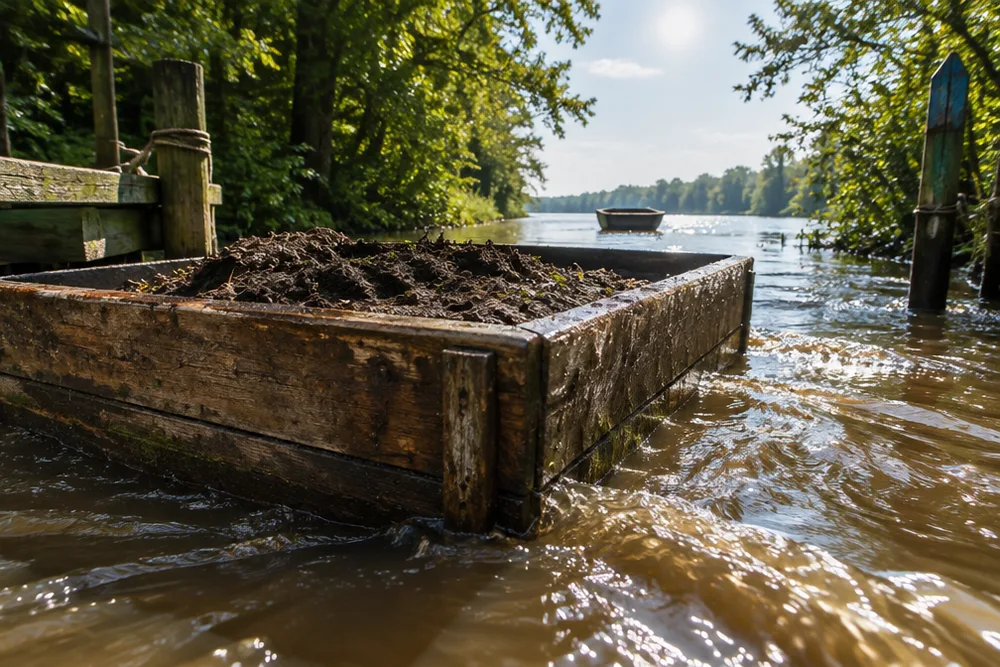
Orla looked. The moving soil box had blocked the narrow return passage between the fixed landing and the outer marker. Even if the punt escaped its present tangle, there was no straight way back. The broad water beyond the row remained open, but the village side was a clutter of hulls, lines and posts. The route around would take them away from the steps and toward the unmarked edge.
A gust brought the smell of wet earth and crushed pear leaves. Orla’s eyes found the trees they had been trying to catch. She thought of the three scows at Spoon Flat, held together by their living nest mat; she thought of every tree she had ever watched move past a mooring without her permission. The old reflex rose again: save what could be saved, whatever else had to wait.
Then the waiting households shifted on the boards. A woman with a bundled baby stood beside an old man who needed both hands to keep his balance. The current pushed at the hulls behind them. The people were not an interruption to the orchard. They were the reason the boats existed.
“We can send the lead hull,” Orla said.
Mera turned sharply. “It’s empty?”
“Empty enough.” The lead scow held only the boards and the long steering pole. “I’ll take it out.”
“You’ll leave the landing?”
“Only until they’re back.” Orla looked to Tallis. “Keep the outer marker in sight. If I can’t come straight through, I’ll bring them around.”