No Breath Behind the Wall
Page 196 of 273
Chapters
A woman named Bess, whose uncle had been listed as having moved north, asked if she should put her ear down. Mara told her she could, if she wanted to, but not to press against the boards. Bess crouched, rested a hand flat on the oak and waited. Her brother, beside her, said, “You don’t have to prove it.”
“I’m not proving anything,” Bess answered. “I’m checking if I can hear.”
Mara recognized the impatience in that voice. It was not faith. It was a person trying to make a room answer a question that had been denied to her for decades.
A soft tick came from the floor. A breath followed, drawn out through the seam between two panels. The sound was thin, almost too small to separate from the noise of the old building. Eda’s fingers tightened in Nel’s scarf. Rafi stopped moving. Across the room, Sari raised her chin.
“Did anyone else—” Bess began.
“Yes,” Eda said. Her voice had gone quiet. “I heard it.”
The breath faded. No one gasped. Nobody said it was Nel. The inspector took a step nearer, but Mara held up one hand. “Give them a moment.”
Bess kept her palm on the board. Her brother leaned over her shoulder without touching her. Across the room, Ola watched the faces with the severe attention of a driver checking a mirror before pulling into traffic.
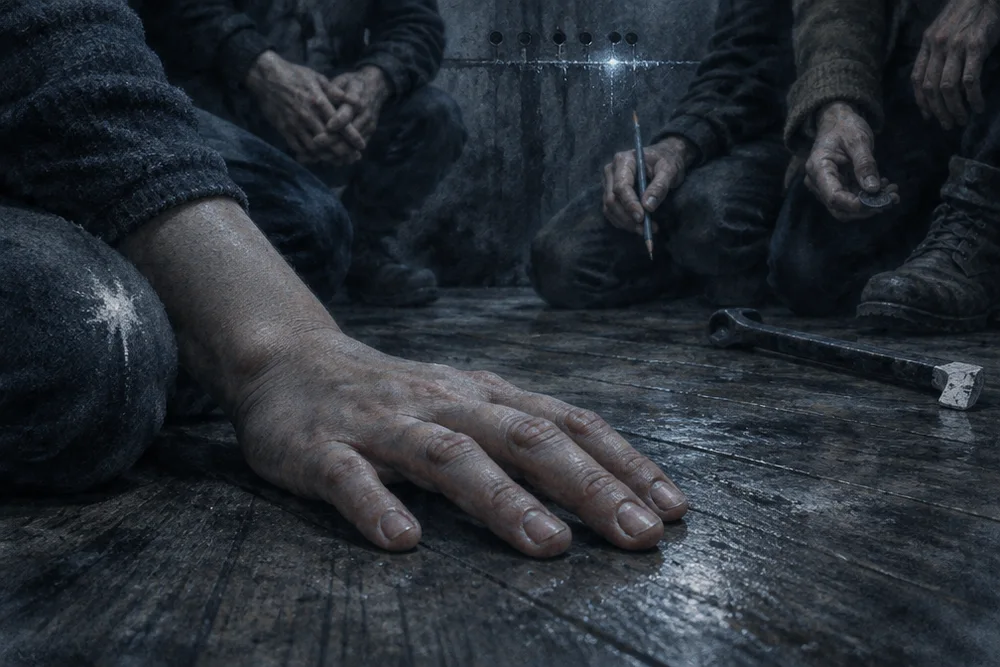
Mara understood that the sound had not made them a family. It had only given them something they could decide whether to accept.
“It’s not a word,” Rafi said. His voice was controlled, almost too carefully so. “It’s a breath.”
“That’s what I heard,” Eda replied.
“Could be the room.”
“Could be.” She folded the scarf once, then unfolded it again. “I didn’t say it was her.”
Mara looked toward the floor. The sprung panels softened ordinary footfalls; underneath them lay the old tile, the hatch and the narrow route toward the laundry. She could hear how quickly everyone wanted a name for a sound. It was the same want that had made the town’s official story so easy to keep: seven workers gone, seven payments made, no need to ask where they had gone or why no one had heard them leave.
A man at the far end of the room cleared his throat. “My mother used to say the laundry had a count. I thought she meant counting sheets.” He was the nephew who had brought the tally. “She wouldn’t say who taught her. Just said if you lost your place, wait for the last one.”