How to Lift a Sunken Road
Page 89 of 233
Chapters
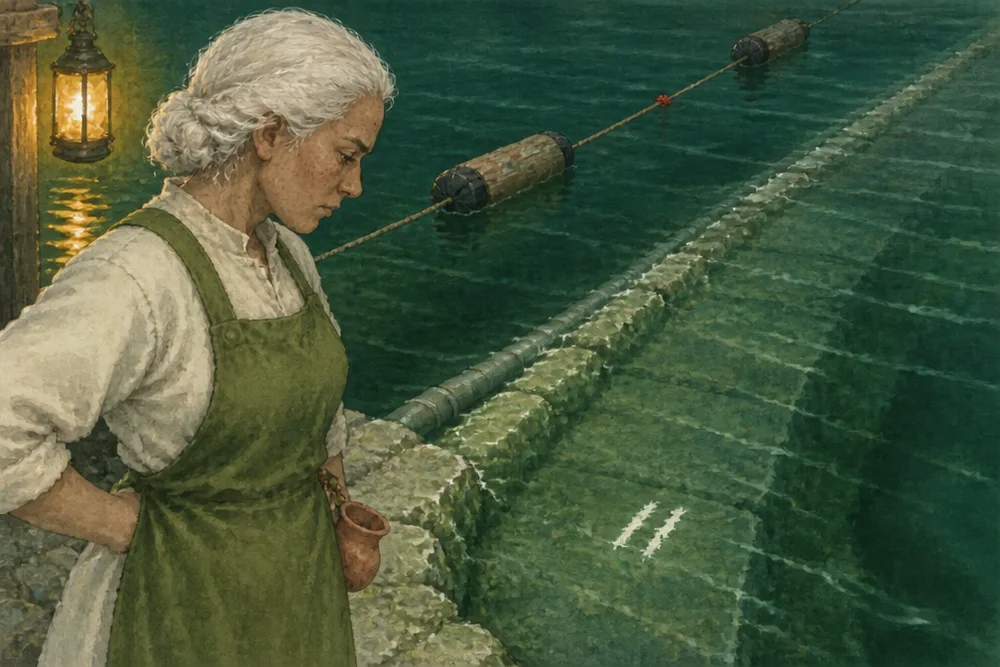
Della angled the sheet so the paired symbols caught the lantern light. They followed the road’s shoreward edge, close to where the first section was rigged for lifting. The water over that line was dark, too deep to see the collars from here. If a pipe ran there, its course could be below the stone and entirely invisible to the sounding cord.
“We’ll need the ledger,” Della said.
“You’ll need to ask for it properly,” Sella answered. “It belongs to the spring house, not the pilot.”
Della folded the map without creasing the marked edge. “Then I’m asking.”
“Not yet.” Sella’s hooded eyes moved from the paper to the laid-out lift gear. “You have not shown me what the stones are meant to buy.”
“A passage for the infirmary.”
“And if the passage costs the village its water?”
“We don’t lift.”
“You said that about the winter landing.”
“And we won’t take it.”
Sella held her gaze. Her freckled face gave away little, but one hand had closed around the cup. “People say no easily when they are not the ones who carry water up the steps.”
Della looked toward the uphill landings, where windows showed warm squares of light above the inlet. The spring shares were held by households there; boat slips belonged to other people and were rented by the season. The village had never been one body with one interest. Tonight, every plan seemed to cross a different boundary.
“You’re right,” Della said. “I can’t ask you to risk the line on a drawing.”
“Good. Don’t.” Sella took the survey’s corner between two fingers. “The ledger can tell us where the line was laid. It cannot tell us if it still carries water. That will take a check.”
“Can you make one?”
“If I have time.” Sella looked toward the dark water. “And if the men who want the stones moved understand that the spring is not a detail in their way.”
Della let the silence stand. She wanted Sella’s help; wanting did not turn it into a debt Sella owed her. “I’ll tell them what we know. And what we don’t.”
“That would be a beginning.” Sella put the cup back at her hip and moved to the edge of the landing, where she could see the paired chalk marks on the first section. Her attention settled there, measuring what the paper could not.