How to Lift a Sunken Road
Chapter 8 · A Stone’s Spare Bed
Page 85 of 233
Chapters
The soundings were still wet on Della’s slate when the crews began arguing over where a lifted stone could go. The first section of the Sunk Causey was marked with two chalk strokes, one for each line of floats. Beyond it, the road ran diagonally through the inlet, pale in the survey’s old drawing and black under the water now. The infirmary waited outside the narrows, its lamps blurred by the lake’s green dusk. Every minute spent planning was a minute of the outer wind gathering strength.
“The hollow,” one of the haulers said. He pointed with his stiff oar toward a crescent indentation near the landing. “Drop each slab there. Easy reach. We can stack them out of the current.”
Nemi had been crouched over the chart. She straightened, turning from the waist to spare her neck. “That’s not a hollow. That’s the winter landing.”
“It’s a landing when there’s ice,” the hauler said. “There isn’t any now.”
“There will be,” Nemi answered. “And it’s the only one a loaded sled can reach without going over the upper steps.” Her jaw tightened around the last word. “You want to borrow it, say that. Don’t call it empty.”
The hauler gave a short laugh. “You’ve got another place?”
“Not yet,” Della said. “But that doesn’t make this one free.”
He looked at her, then at the old plan. “Funny. You used to put safe on a chart before you knew what it cost anybody.”
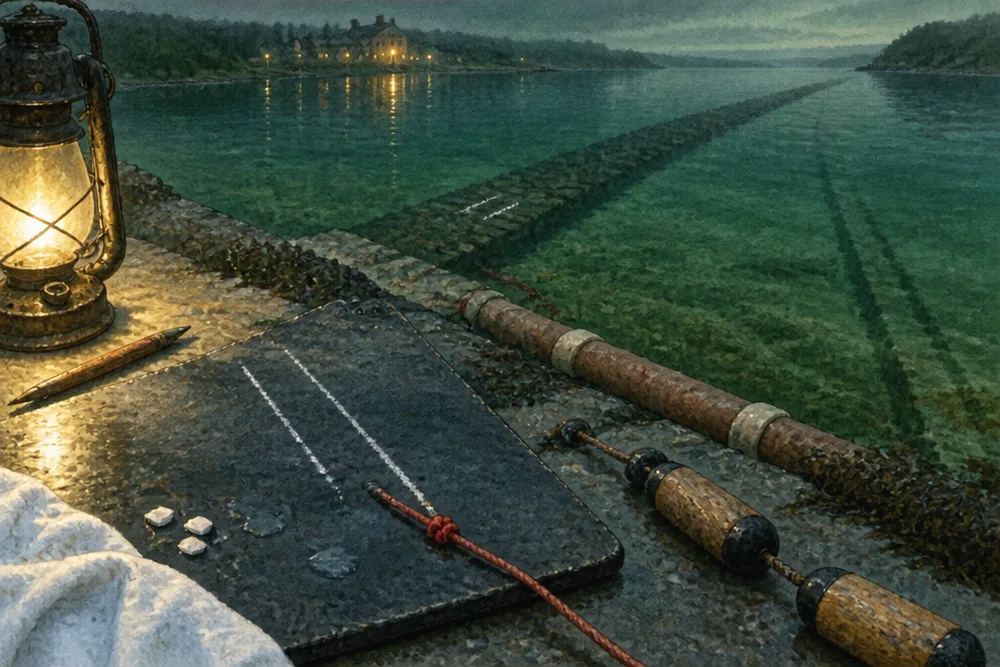
The remark landed cleanly. Della’s thumb moved to the red witness knot on her sounding cord, then stopped short of touching it. “I did.”
Nemi watched her, not rescuing her from the answer. Good, Della thought. The crew did not need rescue from what she had done; they needed a place to put a stone.
“The winter landing stays clear,” Della said. “We’ll find a bed that doesn’t take it.”
“And if you don’t?” the hauler asked.
“Then we don’t lift this section tonight.”
That quieted him more than an order would have. Della had no authority to give orders, and everyone at the water’s edge knew it. She could mark a depth, point out a danger, make a proposal. The crews could refuse her. The infirmary could wait. The lake would not care which of them had been right.
She knelt by the chart, pinning one corner with a coil of cord. On the survey, the road’s stone crown was a double line. Along its shoreward edge, tiny paired marks repeated at intervals. Beside them, a faded note called them drains. The marks had seemed like a surveyor’s tidy way to show seams. Now every line on the page looked like a place where a choice might have been hidden.