Deeds for Drowned Streets, Toast for the Post
Chapter 6 · The Bench Stands Up
Page 69 of 266
Chapters
By Wednesday, Marta had learned to leave the tarred parcel alone without pretending she had forgotten it. Nell kept it locked in the tray beneath the counter; its weight pulled the drawer crooked whenever someone opened it. Marta’s balance sheet remained blank except for the line bearing her relief number. Five shifts had become three, and the date for her pension sat in the green ledger like a stamp waiting to fall.
She worked through the morning’s ordinary post: a bill folded around a seed catalogue, two letters with rain-softened corners, a postcard addressed to a man who had moved inland before Marta began carrying this route. At noon Nell brought the agreement diagram from the weighhouse books. Its paper had gone the color of weak tea, but the line drawn across it was dark and unbroken. Small squares marked the surrendered houses. Beside each, in a second column, stood a replacement plot uphill.
“Waystones,” Nell said, tapping the line with one blunt fingernail. “That’s what the clerk called them. The way runs out to the bell and back.”
Marta studied the diagram. She knew Wick Causeway as a strip of exposed stone, slippery weed and long horizon. She had carried mail along its numbered face many times when she was young. The backs of the mileposts were supposed to be blank. On the diagram, however, a small notation at each post made the return line seem less like a road than a sentence with every word turned away from the reader.
“The gaps don’t match the modern survey,” Marta said.
“The old survey, then,” Nell replied. “If the stones are where the diagram says, you can check it at low tide.”
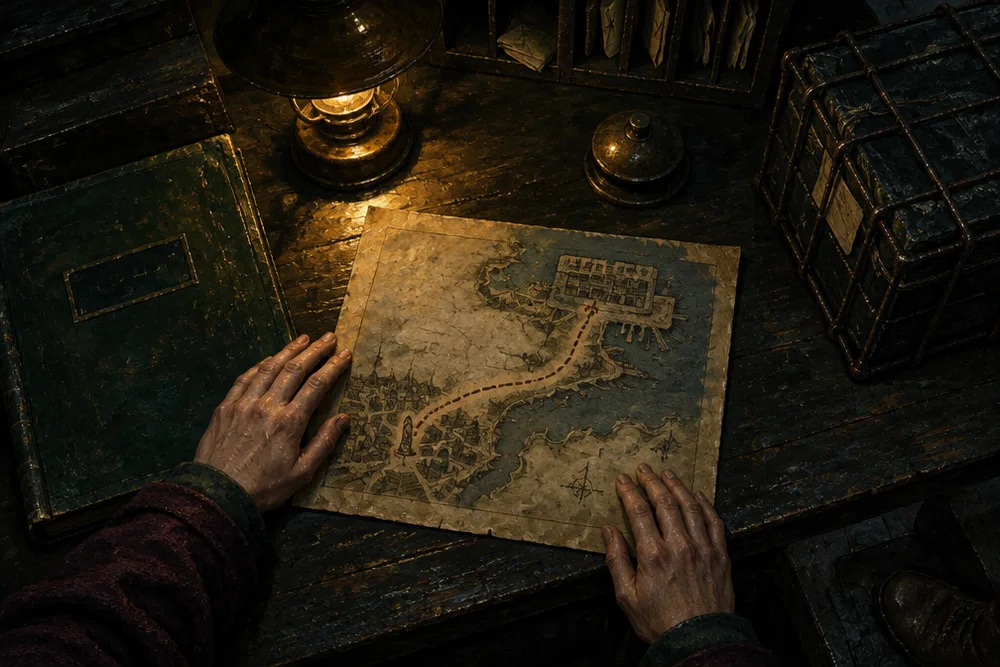
Marta closed the book. “I’ll check.”
Nell looked up from the ledger. “Not with the parcel.”
“I didn’t say I would take it.” Marta slid her brass thumb guard into place. “I said I’d check the stones.”
At the end of the shift, Marta went to Wick Causeway alone. The ebb had uncovered the road’s ragged edges, leaving black pools among the stones and a sheen of water in every crack. On the seaward faces, the mileposts held their familiar numbers. Three was chipped at the crown; four leaned a little inland. Marta carried a measuring tape and a pocket notebook, not the parcel.
She measured the gap from the third stone to the next. Then the next. She wrote each distance down and compared them with the faint figures on the diagram. The first two were close enough to be old measuring, not guesswork. Beyond them, the line bent toward the place where the fish market had once stood, before the town’s shore streets were given up and the market moved uphill.