Deeds for Drowned Streets, Toast for the Post
Page 59 of 266
Chapters
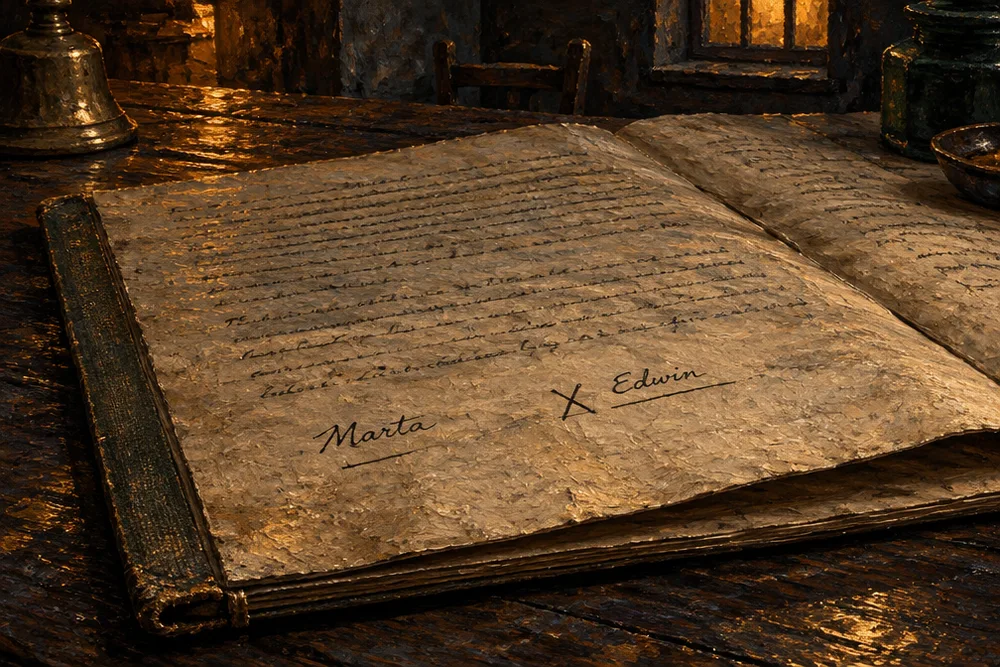
The next volume had been rebound with canvas that smelled faintly of wet rope. Its pages were thick, rough along the edges, and buckled where the old ink had spread. Marta sorted it slowly, checking the impressions before she let Nell turn each leaf. At the back, beneath a sheet of brittle tissue, she found a folded copy of an agreement. The fold had been pressed so hard that its line remained visible through three sheets.
Nell read the heading, then looked up. “This is it.”
Marta did not answer. She recognized the clerk’s sharp downstrokes from the schedule, but the writing had been made in a hurry. There were corrections in the margins and a small mark by the place reserved for the receiving party. Edwin’s name sat there beside the words shore witness. Beneath him was a cramped signature, letters crowded together as if their writer had run out of space.
Marta’s mouth went dry. “That’s mine.”
Nell held the paper steady. “It might be a different Marta.”
“Marta Sedgewick, relief number.” The number matched the one that had appeared in her account on Monday, and the same number printed on the old receipt under the returns-hatch hinge. “I was nineteen. I signed for the bundle.”
Nell said nothing. The silence did not challenge her; it gave the fact somewhere to settle. Marta leaned closer to the thin strokes of her own signature. She had spent decades making her name clean and legible on receipts. This one was narrow, hurried, and unmistakable.
“I thought I was holding it,” Marta said. “Not taking it.”
“Maybe that’s what the signature says.” Nell’s voice had gone softer, but she did not take the paper away. “It records receipt. That isn’t always the same thing as accepting responsibility.”
“In the post, it usually is.” Marta heard the firmness in her answer and wished she had a less practiced one. At Last Window, a name on the receipt meant a thing had passed from one person’s custody to another’s. If the thing went missing, the line of names was the first place people looked.
Nell turned the agreement so they could both read it. Several lines described the lots and their replacement plots. Another stated that a resident could accept the bundled deeds for the town. The wording was legal and plain, the way important instructions often were: no flourish, no warning, only a condition set down as if no one could misunderstand it.
“It says the shore witness accepts on behalf of the town,” Nell said. “That’s Edwin.”
Marta’s finger stopped above his name. “Then why am I on it?”