Deeds for Drowned Streets, Toast for the Post
Page 124 of 266
Chapters
“If I open it, it won’t count as delivery,” she said.
“Who told you that?”
“The rules.”
“Whose rules?”
“The agreement. The town’s.”
“You’ve always liked a rule when it tells you what to do.”
Marta felt the sharpness in the remark. “I’ve liked knowing what I’ve done.”
“That’s not the same thing.”
“No.” She met his eyes. “It isn’t.”
Neither of them spoke. Outside the window was the dark, unchanging sheen of glass. The road, the causeway, and the inland town were all hidden from this side of the kitchen. Marta could not see whether the tide had climbed or ebbed. She could hear no bell. The kitchen kept its own hour, with Edwin’s hand beside the toast and the parcel still across her knees.
He picked up the knife. “You want to see what’s inside, don’t you?”
“I have to.”
“Do you?”
“I can’t carry it back without knowing what I’m refusing.”
“Then open it.”
Marta set the parcel on the table. She kept both hands on it, as though the table might otherwise take it away from her.
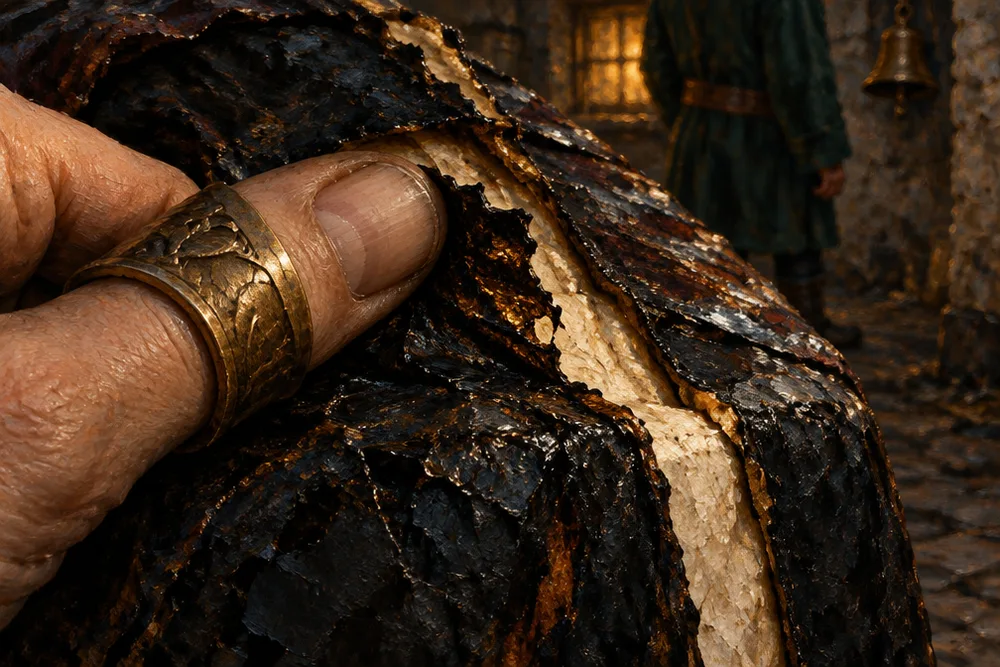
The wrap was palm-sized, tarred dark enough to swallow the light. Three cream seams crossed it from edge to edge. Marta found the first seam with her brass thumb guard and pressed along it. The tar was tough, but not rigid. It yielded with a faint, tacky pull, releasing the scent of wet rope and an older smell of paper kept too long in a cupboard.
“That’s a strange way to wrap documents,” Edwin said.
“It wasn’t meant to be opened.”
“That’s usually why people wrap something.”
“It’s also meant to go through water.”
He leaned toward the parcel. “What did you say it was?”
“The deeds.”
“Which deeds?”
“The surrendered houses. Every lot that went under.”
Edwin’s hand lowered to the table. “All of them?”
“That’s what I’ve been told.”
“And you’ve brought them here?”
“I’ve brought them to the address on the return route.”
“You make it sound as if the road sent you.”
“The road did.”
She lifted the edge of the tarred flap. A narrow strip of cream paper showed beneath, its grain pressed with tiny lines. She did not pull it free. The bundle remained closed, but the wrap had loosened enough to show it contained a flat, tightly stitched packet. Her thumb found a second seam. She worked the tar apart by degrees, careful not to tear the paper beneath. The task demanded the same patient touch as sorting a stack of damp letters: no haste, no force, no assumption that the next layer would be where she expected.