Deeds for Drowned Streets, Toast for the Post
Page 121 of 266
Chapters
He looked at her with the patient irritation he used when he thought she was making a simple thing difficult. That look had once sent her out to fetch the right size of screw from the shed. It had not been tender, exactly, but there had been no doubt that he expected her to come back. Marta had been carrying that expectation longer than she had carried his name on her route.
“I was at the lodging after the demolition,” she said. “You were there, too. We had the stove on the floor between the beds.”
“That’s right.” He nodded, as though she had at last found the beginning of the story. “I carried it over.”
“You were making toast there.”
“Was I?”
“You died later that day.”
The kitchen held its light. The butter shone on the toast. Edwin did not blink or flinch. His hand settled beside the plate, fingers apart, as if the table had shifted beneath them. Marta waited for him to ask what she meant. Instead he studied her face as closely as he had when she was a child and came home with a split lip.
“You’ve got old,” he said at last.
“I have.”
“How old?”
“Fifty-nine.”
He looked past her at the window. The glass reflected the room without showing anything beyond it: table, plate, Marta’s plum sleeve. “That’s more years than I expected you to have.”
“I expected to have them.”
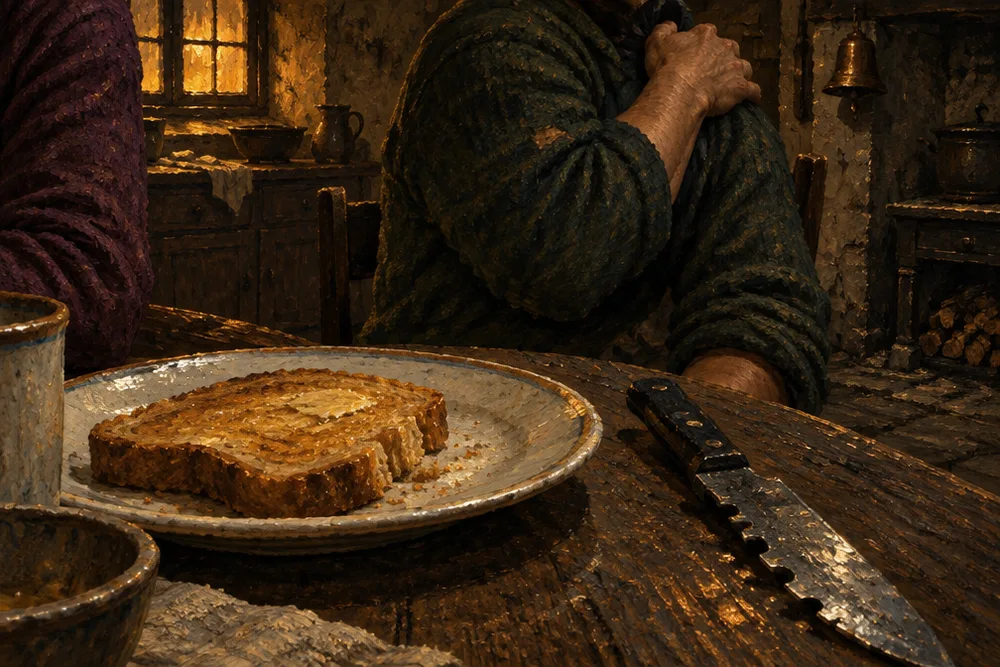
“Fair enough.” He rubbed a thumb over the knife’s dark notch. “I don’t remember dying.”
“I didn’t expect you to.”
“I remember the stove. Carrying it up the steps. It was heavier than we thought, and you kept telling me to put it down before I dropped it.”
“You said it would be easier once it was on the floor.”
“And it was.” He smiled faintly. “Then what?”
“You made toast.”
“I’m doing that now.” He glanced at the plate. “Maybe I’ve been doing it a while.”
Marta looked at the half-finished slice. A ridge of butter reflected the fixed kitchen light. The knife had stopped at the near corner, where Edwin had been working when she spoke. The toast looked too warm to be waiting forty years, and too ordinary to belong to anything she could explain.
“You don’t remember the lodging?” she asked.
“I remember the stove there. I remember you in the doorway, telling me it was crooked.” He touched his shoulder, the one held high. “I remember the stairs. The landlady’s boy running in and out. I don’t remember sitting down.”
“You sat down.”
“I suppose I must have.”