Deeds for Drowned Streets, Toast for the Post
Page 113 of 266
Chapters
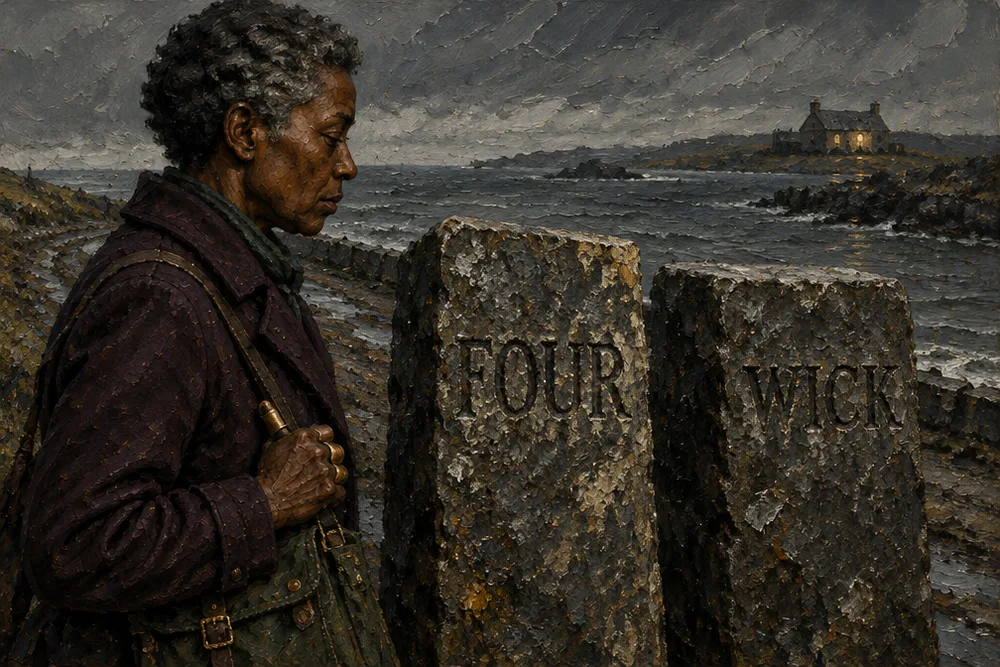
She turned around.
For a moment the causeway remained only what it was: gray stones, wet seams, a line of posts whose faces pointed toward the water. The sky beyond them was featureless. Then the first post seemed to acquire a dark mark, as if a letter had emerged under its weathered skin.
Marta took a step toward it. The mark resolved into a word. It was not painted or carved on a new plate. It lay on the back of the post in the same dark stone as the rest, a ridge of letters picked out by the sideways light. She read FOUR.
The parcel knocked once against her hip as she stopped. On the rehearsal walk she had rubbed grit from this stone and found nothing she could read. She kept her hand away now. The word was plain without touching it.
She moved to the next stone. WICK appeared across its back, letters that seemed to have waited for the turn rather than been uncovered by it. The third gave the vanished lane name, the one erased when the lower streets were taken by the sea and the uphill plots were assigned their replacements.
FOUR. WICK. The lane name.
This was the address on the envelopes from her childhood. She had supplied it herself on the rehearsal walk, when the stones gave her nothing. Now she read it back to herself in the order the road gave it. She had not supplied a letter.
The route behind her seemed longer than it had been on the way out. Posts that had carried only numbers now carried the line of an address, each one lending a piece to the next. There were no street signs, no mailbox, no directions other than the backs of the stones. She kept her eyes on them and followed the words back toward land.
She had walked Wick Causeway as a girl. The old route had been taken away with the old shore, folded into the town’s papers and replaced by the higher road. Yet the posts were showing the route again, not toward the current Bramwick but toward something the town had surrendered.