Before the Bell at Low Water
Page 52 of 247
Chapters
Mara’s expression changed by scarcely more than a crease between her brows. “Those are not for general use.”
“I’m the records clerk.”
“You’re also the person who has just questioned a skipper in the public hall.”
“I asked about a signal.”
Mara looked at the blue sheet, not Gwenna. “Don’t turn a missing man into an excuse to reopen every old return.”
The warning sounded rehearsed only because Mara had said versions of it before. Gwenna slid the blue copy toward her. “I need to know what this zero is made of.”
Mara did not take the page. “You need to let Perrin handle the search.”
“Perrin can’t handle what he doesn’t know exists.”
“He has a missing dispatcher and three witnesses. That is enough to begin.”
“He has three times and a boat that answered.”
“A boat that was on its route.”
“Was it?”
For a moment the hall held only the low murmur of the ticket queue and the drip from the eaves. Mara reached for the blue return and squared its edge with the stack. Her orange cord slid over her coat lapel. “The service has rules for a reason, Gwenna. The inquiry can establish where Len went.”
“The return says there was nobody to take him.”
Mara’s gaze met hers. “Then perhaps he wasn’t a passenger.”
Gwenna heard the sentence as a door closing. That had been the use of the blue copy: it did not have to claim that a trip never happened, only that no trip had counted. It could make a person disappear without removing the boat from the timetable.
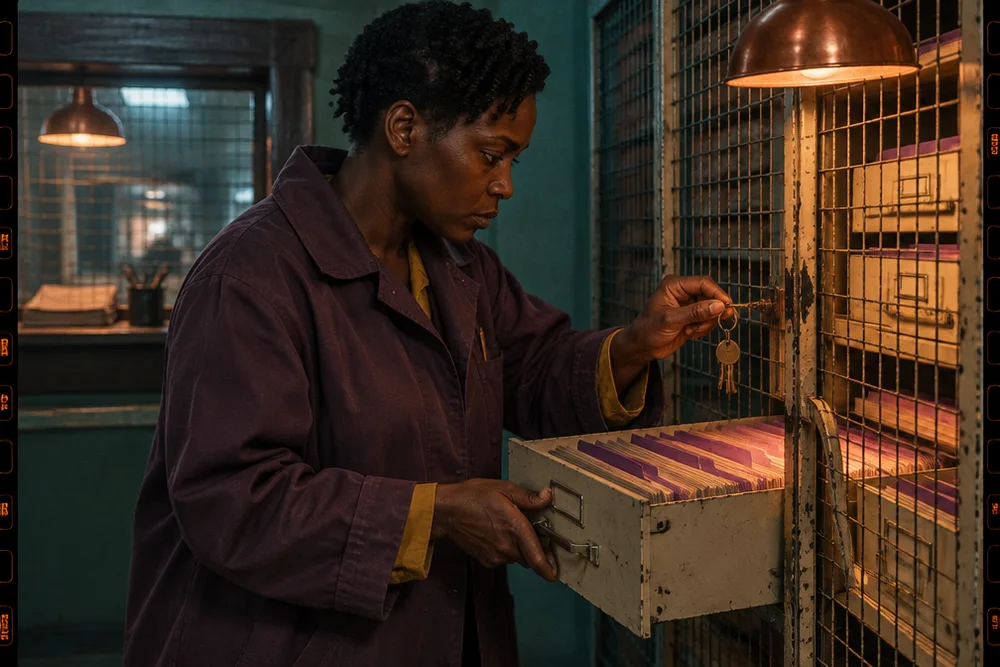
She let Mara keep the return and went to the records cage. The cage sat behind the ticket window, its wire mesh painted once cream and now rubbed dark at hand height. Copper lamps made the papers look warmer than they were. She unlocked the door with the key on her ring and pulled the raw-sheet drawer open.
The working sheets were not blue. They were cream, marked in pencil and overwritten in ink, with violet tabs where a clerk had been told to carry a note forward. They kept headcounts, even when the final returns were meant to show fares or cargo. The sealed sheets had references, not names: initials, route marks, waiver numbers held in a separate register. The system had been built so free passengers could be counted without making their circumstances public.