An Oar for the Fog’s Far Shore
Page 8 of 8
The ferryman was asleep on the step with the lantern between his boots when they came in. Nessa's mother put a hand on his shoulder. He woke, looked at her, and moved the lantern aside to make room. She sat down beside him. Nessa tied up the ferry, and the three of them stayed on the steps while Tobin took the new handle up to the cooper's house. In the first light he had to knock twice before anybody opened the door.
Several weeks later, fog came down while Nessa and her mother were carrying a sack of flour home. A child in boots too big for running came thumping along the quay. The child's parent was out in a fishing boat. Nessa knew the boat, a little brown one that rode low even when it had no fish.
“Will you ring?” the child asked.
Nessa put down her end of the sack. She could feel the old reach in her arm as she went under the bell frame. She laid her palm on the rope but didn't pull. Below her the crossing line lifted out of the water, dripping. It straightened through the iron guide. She took her hand away just before the rope jumped.
The home bell rang. Out near the wall, a pair of oars stopped scraping. Then the far bell answered, low and deep. The child took hold of Nessa's coat. Together they listened while the oars began again, slower this time, leaving space between strokes to hear.
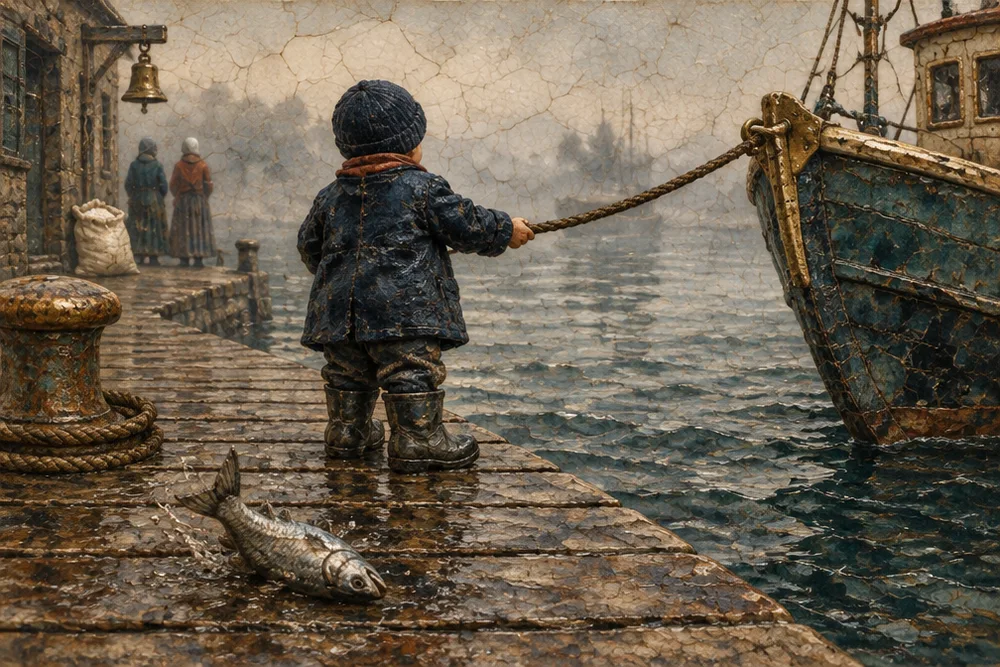
The brown boat nosed into the harbor where the wall curved away from the steps. The child's parent shipped the oars and held up a single silver fish by the tail. The child let go of Nessa's coat and clattered down to take the bow rope. The fish slipped out of the parent's hand and slapped the boards, and both of them laughed.
Across the quay Tobin was turning a basket upside down on his knee, looking for the break. The old ferryman had the herring woman's stool and was holding her board steady for her. Nessa's mother picked up her end of the sack again. There was a white patch of flour on her frayed cuff.
“Ready?” she asked.
Nessa took the other end. As they went up the street the sack swung between them, bumping first against one knee and then against the other.