All the Ears of Clay
Chapter 3 · Black Fork in the Clay
Page 25 of 279
Chapters
On the third morning, Ressa brought a flat pry bar to the Low Bath and set it beside the dead boiler. The child’s tile waited in a padded crate beyond the wind lee, dry and wrapped in a strip of her apron. She had not brought it closer. Even through the lid she could recall the small voice: sorry for letting the bath go cold. The words had no answer in them, only the soft finish of a child stopping when the fragment stopped.
Miri crouched at the boiler’s iron skirt, white measuring cord looped around her wrist. “If we lift the east edge first, the feet won’t scrape the floor.” Her blunt bob was tucked behind one ear; the oversized red jacket bunched at her shoulders. She looked toward Ressa’s gauge, hanging from its usual place at her hip. “Can I?”
“The gauge measures tiles,” Ressa said. “It isn’t a pry tool.”
“I meant the bar.”
Ressa nodded. Miri slid the bar under the skirt and leaned on it. The iron shifted with a dry complaint. Ressa took the weight before it could drop, and together they raised the edge enough to wedge a stone beneath it. The boiler had been cold for years, but its shadow still held a damp mineral smell. Beneath the rim, the old clay was darker than the packed floor around it.
“There,” Miri said. “Black.”
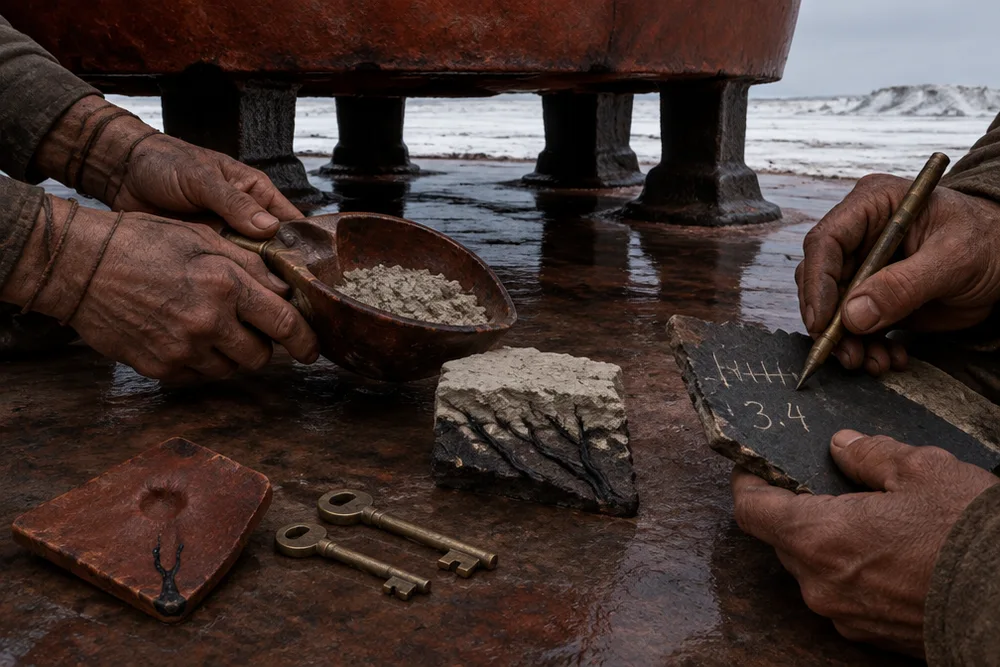
Ressa lowered herself onto one knee. Matte threads forked through the clay, thin as the split in a burned twig. She pressed a fingertip near them without touching. The black mineral was unmistakable. The same fork marked the child’s tile near its thumb dent, though Ressa had first taken it for soot.
“We need a sample from under the foot, not the loose edge,” she said. “And a record of where each piece comes from.”
Miri unwound the cord and laid it in a square around the exposed patch. “You said we’d find the seam.”
“I said we’d look.” Ressa heard her own hardness and softened her voice. “You were right to bring the cord.”
“I’m right about a lot of things,” Miri said, and reached for the wooden scoop.
They lifted the skirt another handspan, bracing it with wedges cut from the bath’s old bench. Miri scraped the surface away in thin layers and called each depth aloud while Ressa wrote it on a broken slate. The upper clay was pale, ordinary, and dry. Below it, black forks began to run together, then split again around pale grains.