All the Ears of Clay
Page 17 of 279
Chapters
Holl Sedge’s surname was well known in town. He kept the fuel ledger at Three Steps and had a low knot of gray twists. But the voice had used it as if addressing someone, not naming its own speaker.
“Holl has a family?” Miri asked.
“Everyone has one,” Venn said. “Some just don’t keep the same name.”
“There’s no Sedge listed on the current register except Holl,” Ressa said. “And his sister’s children took their father’s name.”
“Could be an old name,” Venn said. He sounded more cautious than dismissive now. “Could be another Holl.”
Miri wrote down the words, then stopped. “Should I?”
“Write what you heard,” Ressa said. “Not what you think it means.”
The young apprentice nodded and made a careful note: voice, late clay, heel contact, fragment uncertain. She added the date and the batch number, as if recording a fault in a roof tile. That steadiness helped Ressa breathe.
“Two voices,” Miri said. “Three, if we count the child.”
“We count what we can repeat,” Venn said. “And we don’t make a story out of it.”
“I’m not.” Miri’s pencil paused. “But a surname nobody here carries is a mark.”
Ressa thought of the first voice, the child apologizing for the bath going cold. She had heard it as a warning because it touched the work she had promised to finish. But the clay had not said when, or why, or even that the bath would truly go cold. The apology might be a fragment from some life that would never be born. It might be nothing more than sound bound into a fired piece.
She wanted it to be useful. That desire made her distrust it.
“We test the tiles,” she said. “We see whether the sound is in the clay or in our heads.”
Venn folded his arms. “How?”
“We cut a small piece from one that’s already cracked. Soak it. See if it still speaks.”
Miri looked at the untouched child’s tile. “Not that one.”
“No,” Ressa agreed. “Not that one.”
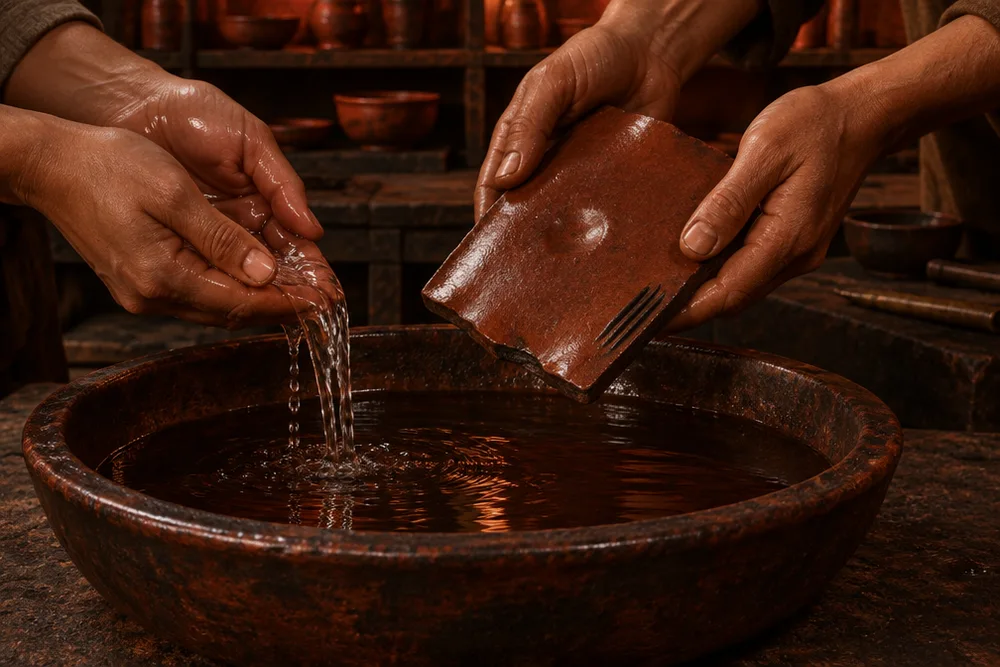
They chose a broken fragment from a late-clay tile that had split during cooling. The crack ran across its thin edge, leaving a shard small enough to fit in Ressa’s palm. It bore no mark beyond the same fine gray fold Miri had recorded in the batch.
“We’ll use the basin,” Venn said. “If it’s going to shed grit, I don’t want it in the kiln trough.”
They carried a washbasin from the side shelf and set it on the bench. It was dark, polished clay, its rim worn smooth by years of hands. Miri poured in a finger’s depth of water. Ressa held the fragment above it.