A Place for the Knocking
Page 64 of 286
Chapters
Zora drew back. Her coat sleeve brushed a flour tin, which shifted with a soft scrape. She steadied it and set it farther from the edge. The tin’s label, in her mother’s rounded hand, said RYE. Iven had labeled everything, even the jars that had never held anything but buttons. It was the sort of detail that turned a memory into a room you could enter: the ink smudge on the label, the small dent in the tin’s lip, her mother’s thumbprint in dust.
The band rounded the next street. The melody arrived more clearly, then receded beneath the scrape of many shoes. Zora stayed facing the cupboard, trying to decide whether the sound had come from the wood, the walls, or somewhere in the old, difficult part of her mind that still made a home out of this flat.
“Iven?”
The name had been in her mouth before she meant to say it. She had been carrying it for months without using it aloud. The last time she had said it in this kitchen, she had been alone, trying to remember which roof contractor her mother had cursed most vividly. The name had tasted like a fact then, dry and brief. Now it hung in the room, and the air seemed to tighten around it.
The pantry light changed. Nothing crossed the window. The sun remained steady on the opposite wall, but the dark between the cupboard shelf and the panel deepened into a shape that suggested a shoulder, a bent head. Zora took a step back. Her palm found the edge of the kitchen table. One of the keys bit into the wood as the ring swung.
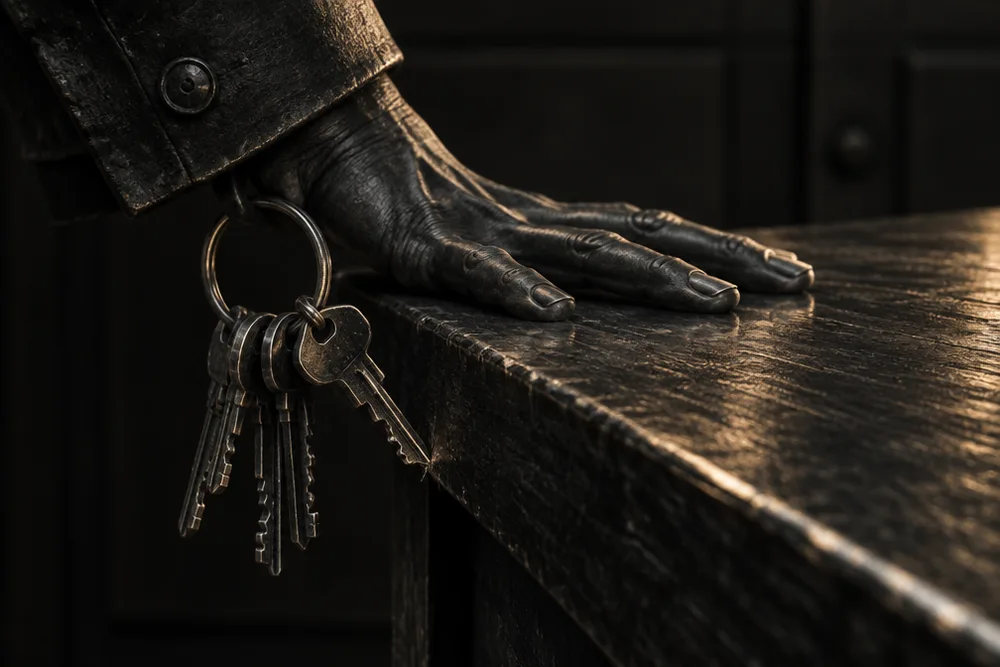
There were two knocks, the second weaker than the first.
“Why does the city keep me awake?” her mother asked.
The voice came from the cupboard, but it was not trapped there. It sounded as if Iven were standing at the kitchen counter, speaking over the clatter of a kettle. The rasp at the end of her vowels was exact. So was the low, tired gentleness that had once persuaded Zora to take off wet boots before coming in. No breath warmed the pantry air. No shadow moved beneath the door.
Zora’s mouth opened. She could not make a sound.
In her mind, she saw her mother as she had last looked in the flat: silver braid flat against the back of her head, cardigan worn pale at the elbows, one wrist braced on the table as she leaned over a stack of repair bills. Iven had been short and broad, with thick hands made clumsy by aching knuckles. She used to take the roof stairs two at a time anyway. Later, she’d sit with her feet up and pretend she was resting because she had earned the right, not because her joints hurt.