A Place for the Knocking
Chapter 26 · Leave It Shut
Page 256 of 286
Chapters
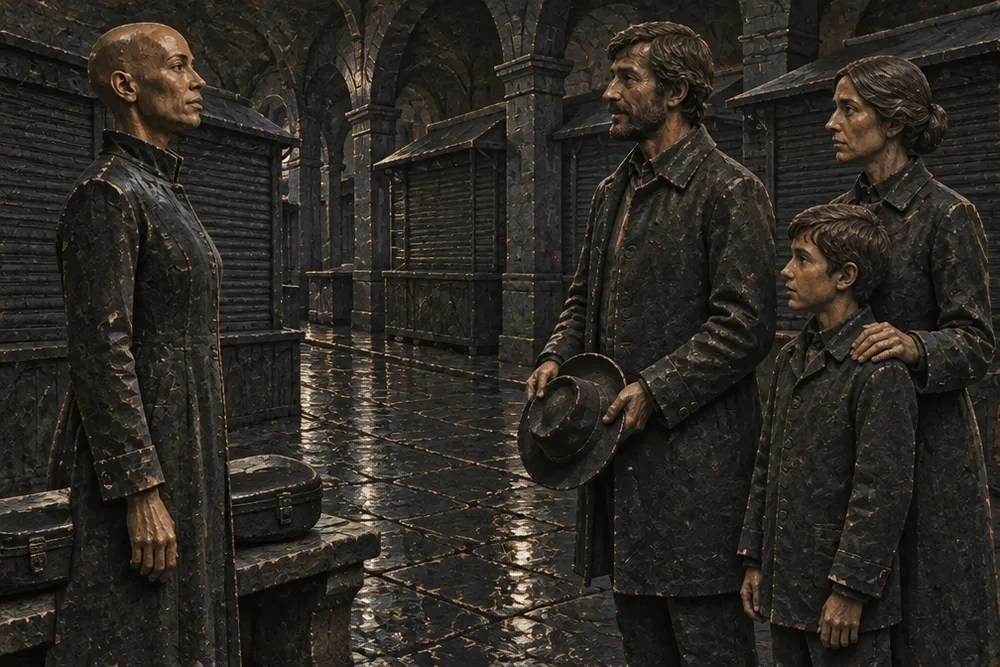
The first family came to Tess Barram with a request for silence. They waited beside the bandstand in the market arcade, where the stone ceiling held the day’s damp and the last rain had left a dark seam between the paving slabs. Their coats were still buttoned against weather that had passed. The father held his hat in both hands; the mother kept one hand on the shoulder of a boy who watched Tess’s brass instrument case as if it might open by itself.
“We don’t want the procession,” the father said. “Not this year. But we thought perhaps you could walk without playing.”
Tess had heard the request in other forms since the solstice. Walk quietly. Don’t play the old tune. Don’t stop at our street. Let us come and watch from somewhere safe. Each version made the same assumption: that the city’s annual walk could be altered by leaving out the music, as if the music were a coat the dead wore rather than the road they followed.
“A silent procession is still a procession,” Tess said.
The father looked down at his hat. “Then perhaps there shouldn’t be one.”
Behind him, a fruit seller dragged a crate over the stones. The scrape made the boy flinch. His mother drew him closer, and Tess felt the old reflex rise in her: to soften the room, to offer a familiar phrase, to make a promise that would get them through the next minute. She had once believed a steady cadence was kindness. Now she knew it could be a hand at someone’s back, pushing them toward a door they had never meant to open.
She set her case on the bench. “I won’t lead the march.”
The father lifted his eyes. “You can stop it?”
“I can stop my band from playing for it.” Tess let that distinction stand between them. “I can’t tell the whole city what to do.”
The mother’s fingers tightened on her son’s shoulder. “Would you play something else?”
“If there’s somewhere to sit.”
It was a small answer, but the father’s hat stopped turning in his hands. The boy glanced from Tess to the arcade’s long row of shuttered stalls. None of the doors stood open. Nobody had posted an invitation there. That, Tess thought, might be a beginning.
At the bandroom, the musicians had already heard three different versions of what Tess had promised. They waited among instrument stands and folded chairs, their cases open like dark mouths. An old trumpet player named Harl had brought the sponsor’s letter, though the sponsor had withdrawn the wages and asked whether they might reconsider if the procession went ahead after all.