A Place for the Knocking
Page 38 of 286
Chapters
The oldest address was not the flat’s present number. It belonged to a lane that had been renamed after the market arcade went up, and the lane no longer existed on any current map. Zora knew its trace from the slope of the buildings. The old houses had been built tight against one another, their upper stories leaning across narrow passages; when the arcade came, the passages were roofed over and turned into stalls. The street survived as a crooked run of stone beneath the market floor.
She went there at lunchtime. The arcade was crowded with shoppers ducking in from the rain, the air a mixture of frying oil, wet wool, and the green smell of fish laid on crushed ice. Vendors called out prices. A boy with a handcart squeezed through the traffic, ringing a bell. The noise rose beneath the glass roof and came back in a softer, muddier echo.
Zora asked an elderly stallholder where the old Wrenwick lane had run. The woman pointed with a cleaver toward a row of spice drawers. “Under there, I’d say. Or under the next stall. You don’t go looking for old streets unless you’ve lost something.”
“I’m trying to find the old entrance to number twelve.”
“Then you’ve lost something.” The woman gave her a look that suggested she had already answered enough. She went back to chopping parsley.
Zora walked the arcade’s length, counting doorways and measuring their spacing against the old bills. The numbers on the invoices followed a rising sequence, then stopped at the Wrenwick property. The next entry was a public stair, then a small boarding house that had vanished. She marked each point on a scrap of paper. The line seemed to run uphill, away from the harbor and away from the route of the yearly procession.
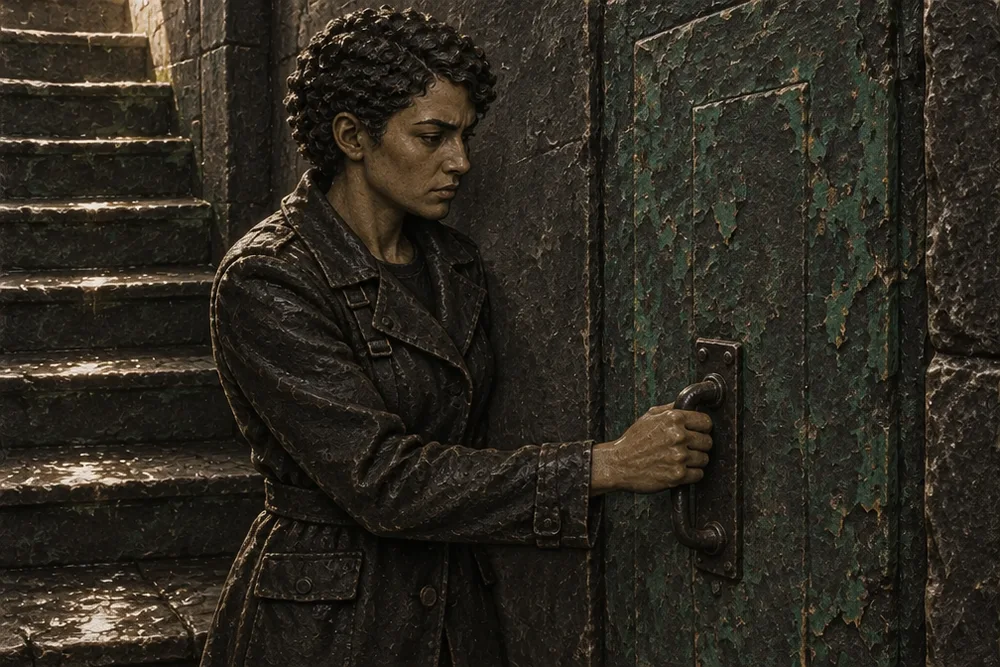
At the east end of the arcade, a stair climbed between two storage rooms. One door had been painted over; its outline showed under the green coat as a dark rectangle in the stone. She tested the iron handle. It did not move. A newer lock had been fitted through the old plate, and the keyhole had filled with paint. Zora scraped the paint away with the corner of her brass caliper. The keyway was narrow, its wards unlike any lock she had seen in modern civic use.