A Fair Share of Winter
Chapter 8 · The Warmest Branch
Page 97 of 286
Chapters
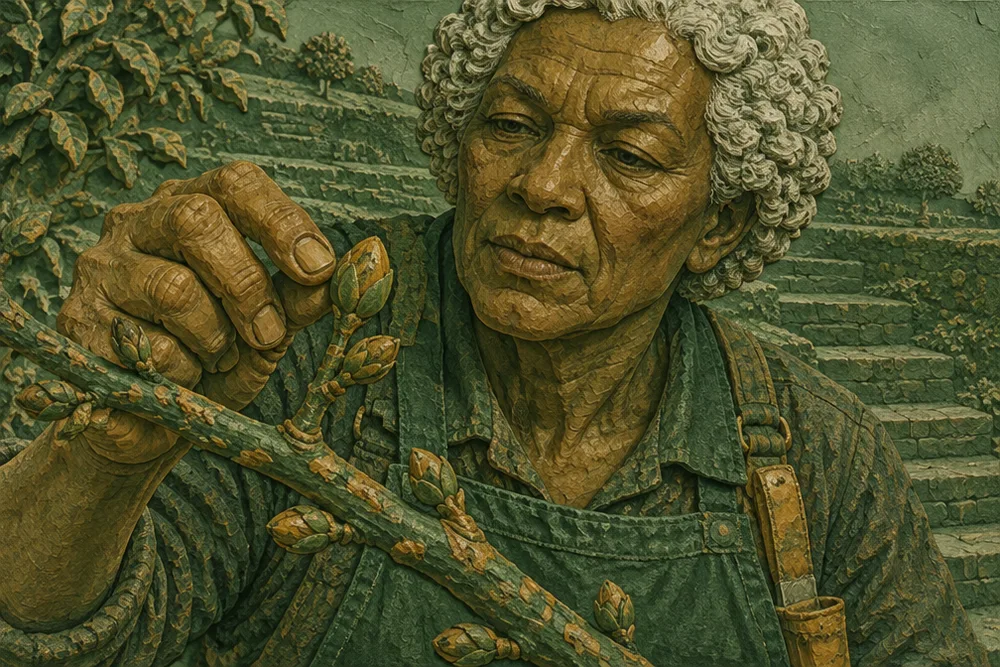
The test interval had been crossed off the delivery slate in red. Xanthe stood below the Brindle Steps with the slate tucked under one arm, watching the uppermost pear branches take the morning first. Sun touched their tips while the lower terraces remained in the stone animal’s shade. The buds there were tight, green-brown knots. At the top, two had opened their scales enough to show pale wetness within.
She had wanted a clean result from the manifold: a number that could be carried into the hearing, proof that a measured share would leave the Underfold warm and the orchard cold. Instead, the full draw had stopped both services. Jory and Sella had brought the exchange back, but the interval was gone. The remaining days had narrowed by one, and the pipes had not learned mercy from being watched.
Ibb Brindle sat on her folding stool halfway up the public stair, her patched apron neat over her knees. The ocher knife sheath at her waist was empty; she had left the grafting knife with the apprentices. She leaned toward a branch, bent left thumb pressed against one bud as though she could keep it shut by touch. “That one’s starting,” she said. “It shouldn’t be.”
Xanthe shifted the slate. The two ocher ties left at her wrist rubbed against its edge. The third, pinched behind the manifold stop during the test, was still there in her mind as sharply as if the cloth remained. “How many?” she asked.
“On this row? Three, since yesterday.” Ibb withdrew her hand. “The high branches warm first. You know that.”
“I know. I wanted the meter to say something else.”
“Meters are very obliging when you want them to.” Ibb’s mouth tilted, not quite a smile. “Trees aren’t.”
Xanthe climbed the stair beside her mother. The orchard rose left to right above the public steps, row after row of narrow trees trained against pale scraped plaster. Their roots held in troughs cut into the terraces; their branches reached over the stair, where fruit sellers once arranged baskets beneath them. The stall boards were folded away now. Xanthe had spent the last three days thinking of the crop as a claim, a quantity on paper that someone had taken. Here, with the upper buds loosening, it was a sequence of decisions already happening without her.
Ibb pointed out the vulnerable branches as they went. Not all the cultivars needed the same chill, nor did all the rows wake at the same rate. Some lower trees could wait. The warmest terrace could not. “If we put all the cold where the deed says, we lose them anyway,” Ibb said. “Not because the right’s false. Because we’ve let the right become the plan.”