When the Streetlights Grew Leaves
Page 41 of 207
Chapters
“That’s quick,” Iona said.
“Vale doesn’t like a question arriving before he has a statement prepared.” Mera folded the notice. “He’ll want to know what you intend to do with the copy.”
“Let both banks read it.”
“That is what you’ve done.”
“Then he can hear it from me.”
Mera gave her a long look. “You’ll be asked whether you meant to accuse the city.”
“I meant to show the report.”
“That answer is true, and it may not be enough.”
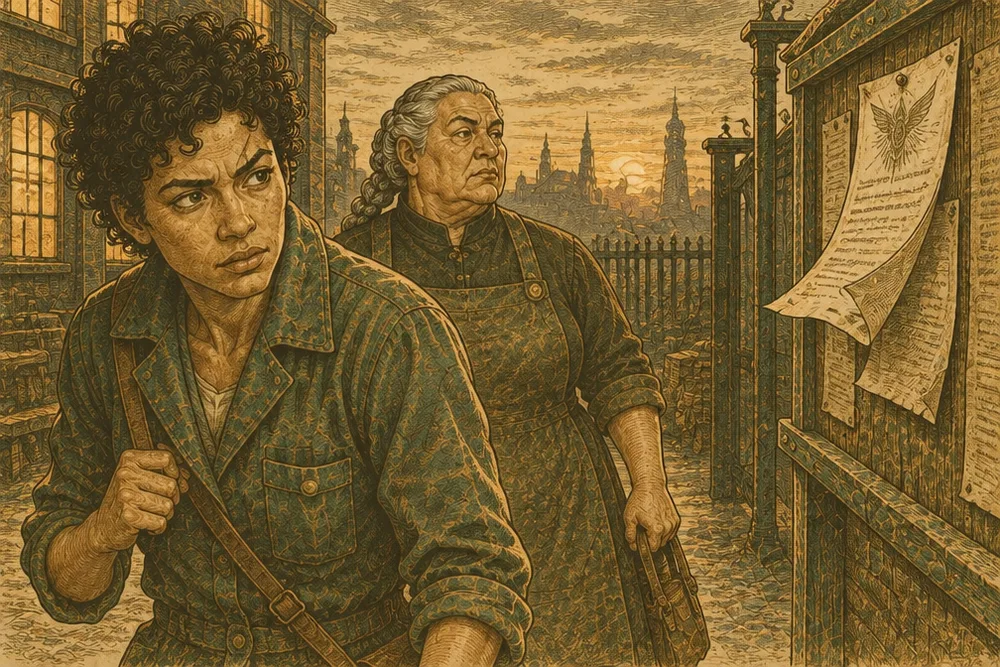
Iona glanced back at the notice board. The pages fluttered in a draft from the yard entrance. Beneath them, someone had pinned the hand-copied citation for Reedbank to take away. The old record had become a public object, though the original remained locked in the archive. That difference mattered. It meant the city could no longer pretend that only its own clerks had seen the order.
A workshop bell sounded the hour. Iona’s meter slip pressed against her thigh inside the coat pocket. The cap on the leafing lamp would hold through the night, unless the inspection office altered its terms. Her signed responsibility still stood. She could not step away from the lamp simply because the record had grown dangerous.
“Tomorrow,” Mera said, “we take the complete file to the hearing. Not the summary alone.”
“And the copy?”
“It stays where it is until the board orders otherwise. If the board orders otherwise, we ask why.”
It was not a promise of protection. It was a plan, and Iona understood the difference. Mera had signed once without reading the whole record. Now she was willing to stand beside the pages, though it might cost her authority as well as Iona’s apprenticeship.
They left the yard together. Behind them, the two districts’ questions had begun to travel in opposite directions: uphill toward the commissioner’s office, and downhill toward the river landing. The old report had not answered whether the lamp’s roots were a failure or a way for the grid to recover. It had made clear that no single answer could be trusted without showing who paid for it.
At the gate, Iona looked once more at the posted annex. The paper was small against the soot-dark wall, but its lines could be read from the path. The blackout had been called an interruption for six years. Now it had a relay order, a date, and a public citation. By morning, it would have a jurisdictional dispute.