When the Streetlights Grew Leaves
Page 23 of 207
Chapters
At that, the crowd changed shape. A woman with a flour-dusted sleeve drew her shawl tight. A man near the back called, “My mother uses the lift.”
“It’s a test,” Iona said, louder. “A moment’s interruption, not a cut.”
“The last time someone tested a branch, we lost power for half a day,” the man replied. His eyes stayed on the wrench. “And you’re the one holding it.”
The accusation landed in her square pocket, among the tokens and fuses. She knew the woman’s building. She had serviced its lift twice, once after a jam, once after the brass brake started slipping. The lamp was not an isolated piece of iron. Nothing in Kilnside was isolated; every line ran beneath a floor, behind a wall, into someone’s daily arrangements.
Iona eased the second bolt free. The splice parted with a soft snap. The lamp’s hum vanished. For a heartbeat, the alley seemed to widen around the sudden quiet. Then the meter needle fell to zero.
The leaves tightened. Their edges drew inward, turning slightly brown at the tips. One by one, the fine filaments along the iron neck slackened. The lamp remained upright, but its branches seemed less like growth than a hand closing around a thing it could not keep.
Iona leaned close to the meter. The main service line still carried its ordinary load. The lamp’s demand had been real. It had not been a reflection or a fault in the gauge.
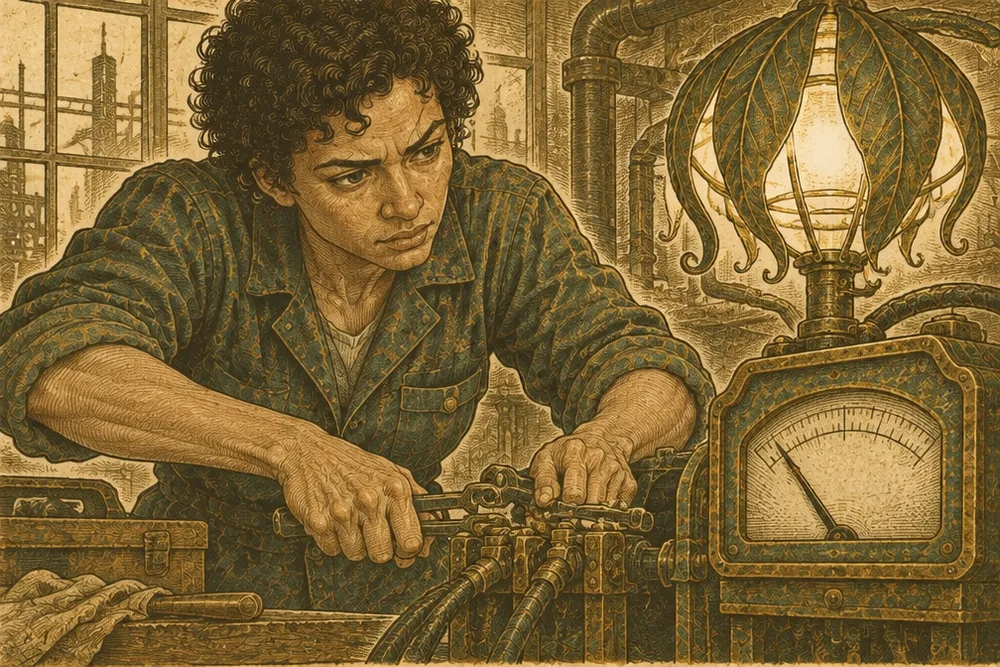
“There,” Mera said. “It was drawing power. Put the seal back and prepare the saw.”
“The roots are still connected to something.” Iona pointed to the filaments disappearing under the paving stones. “They’re not drawing current, but they haven’t gone slack.”
“We don’t leave an unlicensed conductor embedded in a public street.”
“We don’t know that it’s conducting.”
“We know it grew where no growth belongs.” Mera’s voice had the rigid calm she used when a student had made a mistake and a supervisor might be listening. “The order is to fell it.”
Iona looked at the curled leaves. A thin brown line had appeared along one vein. It ran from the tip to the stem and stopped. She thought of the voice in the lamp, the voice that had said a name—Nell—and the buried garden gate. She could still hear its rasp, the faint scrape in the middle of a familiar phrase. Nothing about the sound proved the dead had returned. Nothing proved the lamp could survive either.