When the Streetlights Grew Leaves
Page 128 of 207
Chapters
A pair of lift users arrived from the upper tenements. One carried a narrow board with names and service floors written in charcoal. Orr had sent them, Iona guessed; his hand was not on the board, but his habit of listing everyone who depended on a circuit was. They read the reserve figures and began adding names beneath the lift line.
“That doesn’t change the draw,” Iona said.
“No,” the taller woman answered. “It changes who we’re talking about.”
She set the board against the ledger rail. The names blurred slightly where the charcoal had met damp air, but the floors remained legible. A boy from the pump ward paused to read them. Then he pointed out that one of the listed homes had its own ground-level access. The woman corrected the mark, without complaint.
Mera watched the exchange. “You put the cost where people can see it,” she said. “Now they’re putting themselves beside it.”
“That still isn’t a sponsor.”
“No.”
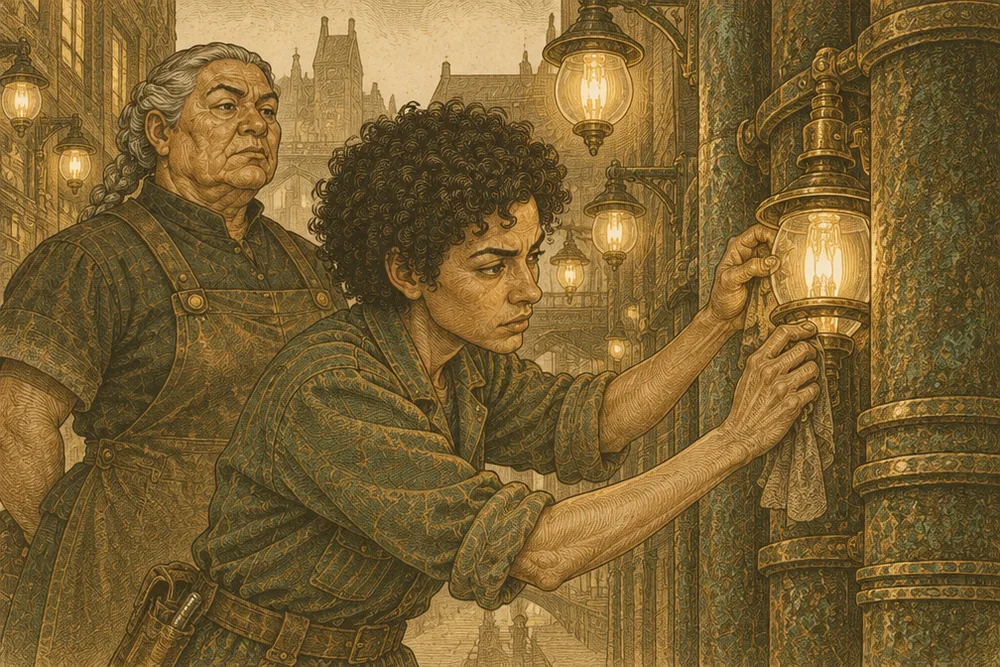
The bell rang for the evening allocation check. Across Kilnside, lamps began to come on one by one: first the lift tower, then the stair landings, then the workshop windows. The living fixtures showed their leaves as dark shapes around their bare centers. At the junction, a delicate branching silhouette traced the glazed core. It did not glow on its own; the feed carried current through its roots, and the leaves only marked the paths where load was being shared.
Iona watched the workshop lights remain bright. For now, the old schedule still held. In six days, the city would ask the lamps to go dark unless the districts could agree on custody, debt, and rationing. Her honest figures had given them one possible route. They had also shown how much that route would demand from the people who kept Kilnside working.
She finished the tea. The tin lid was cold at the rim.
Mera released the ledger page. It hung straight beneath its clips, the loss line visible from the courtyard entrance. No stamp had been added beneath Iona’s signature. No institution had claimed the plan. The numbers stood on their own, complete enough to argue with and too costly to pretend away.
Across the river, Reedbank’s landing lamps appeared in the distance, each a low brass dot against the dark. Iona folded the shutdown notice and placed it beside her apprenticeship slip. She had no sponsor. She had no credential guarantee. She had six days to persuade two banks to accept the same loss without hiding it in one another’s accounts.