The Week We Borrowed a Kitchen
Page 35 of 172
Chapters
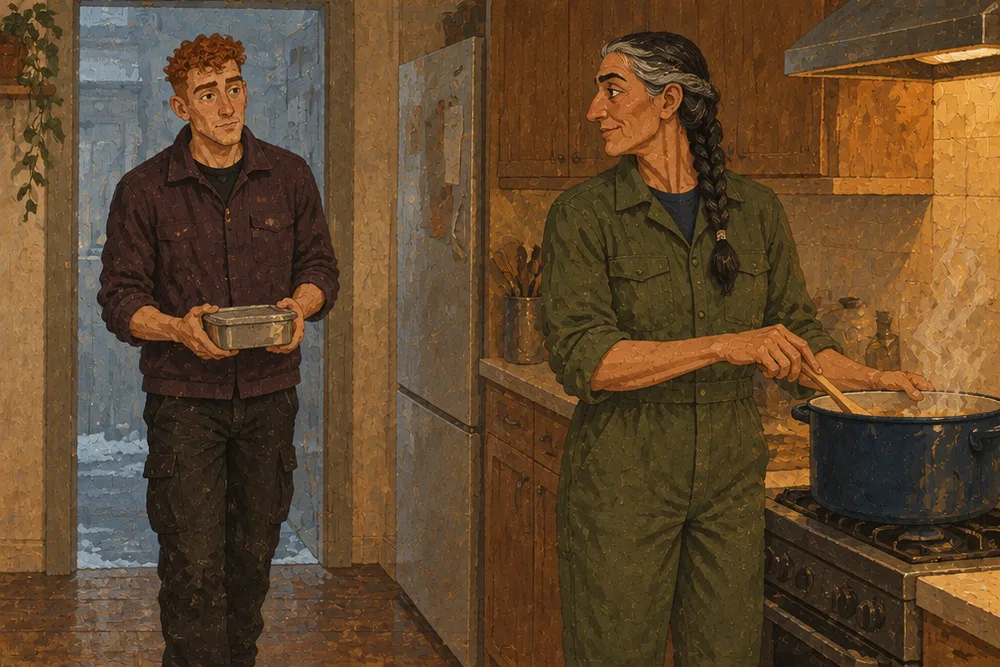
“You’re Mina, right?” he said. “I’m Rafi. I was told there was a pickup tonight.”
Mina’s hand tightened on the wooden spoon. The sign had said supper, not pickup. She had meant two portions, at most, and one of them was hers. “There isn’t a pickup,” she said. It came out too briskly, though she had been waiting for nobody at all. “I’m cooking for myself.”
Rafi glanced at the tin in his hand. “I thought the notice meant—”
“I’m sorry. I don’t have enough.” Mina turned back to the pot, then turned again, because speaking to someone’s back was worse. “I didn’t plan for more people.”
“That’s fine.” He kept his voice level. “I can take it somewhere else.”
The tin was clean, with a faded blue stripe along its rim. Mina wondered what he had expected to put in it, or whether he had expected to fill it here. She could have asked. The answer might have required her to change something, and the lentils had been measured out before she knew there was a question. She felt the thin irritation of being interrupted, then the shame that followed it, less useful and more persistent.
“The notice says supper,” Rafi said, not accusing her. He looked toward the board by the door, where the word was still visible through the glass panel. “I have to be home soon. Someone’s covering for me for half an hour.”
Mina set the spoon down. “I’m sorry. I didn’t think through what I was advertising.”
“No problem.” He stepped backward, tin tucked against his hip. “Maybe another time.” He did not wait for her to say that there would be one. The accessible door gave a soft rubbery thump when it shut behind him.
Mina remained where she was, one hand on the counter. The word supper, seen from inside, appeared larger than it had when she wrote it. She had pictured a small notice that would explain why she was using the hall, not a promise. She had imagined that people would understand the scale of what she meant by looking at the two plates. Rafi had looked at them and understood something else.
She turned off the burner and tried a lentil. It was still firm. The onion smell had sunk into her cardigan. She thought of going home with the pot and eating it at the oak table, where four pale chair marks showed on the cork floor. Two chairs remained, though she had given the others away before the boiler failed, one at a time, as if a person could dismantle a shared life through small errands and never have to name the whole thing. The empty marks had been visible all week. She had not covered them with a rug.