The Week We Borrowed a Kitchen
Page 14 of 172
Chapters
Mina set the pan down. The knob clicked, then the flame caught, blue at the base and orange at the tips. It warmed the air above the grate. She added a little oil from the bottle on the counter and lowered her pieces into it. Their wet surfaces spat. She was still learning the stove when a man came through the street door with a dark plastic crate against his hip.
He was tall and lanky, with copper curls shaved at the sides and a plum work fleece zipped to his throat. His forearms looked longer than the crate needed. He stooped as he passed under the doorframe though there was plenty of clearance.
“Oren,” Della said. “You’re late.”
“I’m not late. It’s the same time.” He set the crate on the floor and straightened, rubbing a palm down one cargo-trouser thigh. “The shift ran over.”
“It always runs over.”
“Yes.” Oren looked at Mina, then at the stove. “New person?”
“Mina. Borrowing the room.”
“Ah.” He nodded once, as though this explained all the arrangements, and lifted the crate onto the counter beside the fridge. It held a dozen shallow takeaway cartons, stacked two high. None had a name on them. He opened the refrigerator and began fitting them onto its last clear shelf, adjusting and rotating each carton until the lids sat level.
Mina’s half-potatoes browned on one side. She turned them over.
“What’s in those?” she asked.
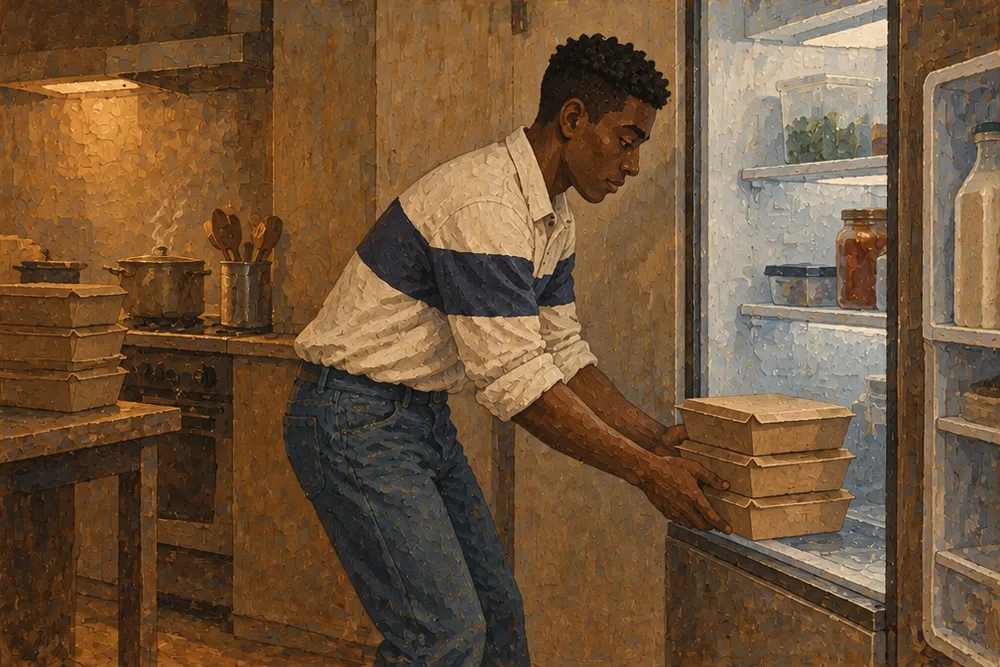
Oren’s hands paused on the fridge door. “Food.”
Della gave him a look over her shoulder. “That’s not what she means.”
“Rice, mostly. Lentils. Some chicken. I think the top row’s vegetable.” He tapped a lid. “I made a list once and it got wet.”
“And the date?” Mina asked.
Oren glanced from her to the cartons. He was young enough to look as if the question should have an easy answer, but his brows drew together. “Today. Some of it. The rest is Sunday.”
Della turned the oven knob off and on again, not quite listening. “That’s why they’re there.”
“For whoever needs them,” Oren said.
Mina set down the fork she had been using to turn her potatoes. The phrase came back. Whoever. In the kitchen it meant people might arrive hungry, or might not. Food could be waiting without any particular person being expected to claim it. The cartons gave no clue which ones were safe to take, and nobody had been asked to decide.
“Does anyone take them?” she asked.
“Sometimes,” Oren said. He shut the fridge. “Sometimes not.”