The Way Back to Bell Street
Page 173 of 227
Chapters
Meena wrote his name in the four-twenty square. Her letters were narrow and upright: RAFE TERNAN. The block looked ordinary among the blank ones. He liked that more than he expected. “Do you want a reminder?” she asked. “I’ll remember.” “People often say that and then get caught by a late ferry.” She gave him a small paper copy anyway. “Keep it dry.” He folded it once, carefully, and put it in the inside pocket of his rust rain shell. “Thanks.” The passenger with the trolley was still discussing the crossing. Meena stood to point at the tide board, the counter edge catching the light from the terminal windows. Rafe moved aside to let them reach the staffed window. On the way out, he passed the row of seats where people waited by habit rather than ticket class. One was empty, its blue-painted slats worn pale at the edges. He thought of the room beneath the school, with its low mantel and its parlor door trapped inside a later brick infill. The bell would be clipped to its plate. It would wait there whether he did or not. He had wanted the turn to be a door that led straight to his father. Now he had a time, a rule, and a chance that the room might give him nothing at all. He walked toward the slip without practicing what he would say.
Pippa was at the bottom of the gangway, arguing with a sheet of paper. She had it flattened against the rail with one forearm and was trying to get the other half out from under her elbow without letting the whole thing go. The wind coming along the slip kept making a pocket in it.
“Take that corner,” she said when she saw him.
Rafe took it. A man behind them cleared his throat. They let him through, then went aboard holding the sheet between them like something wet they’d taken off a line.
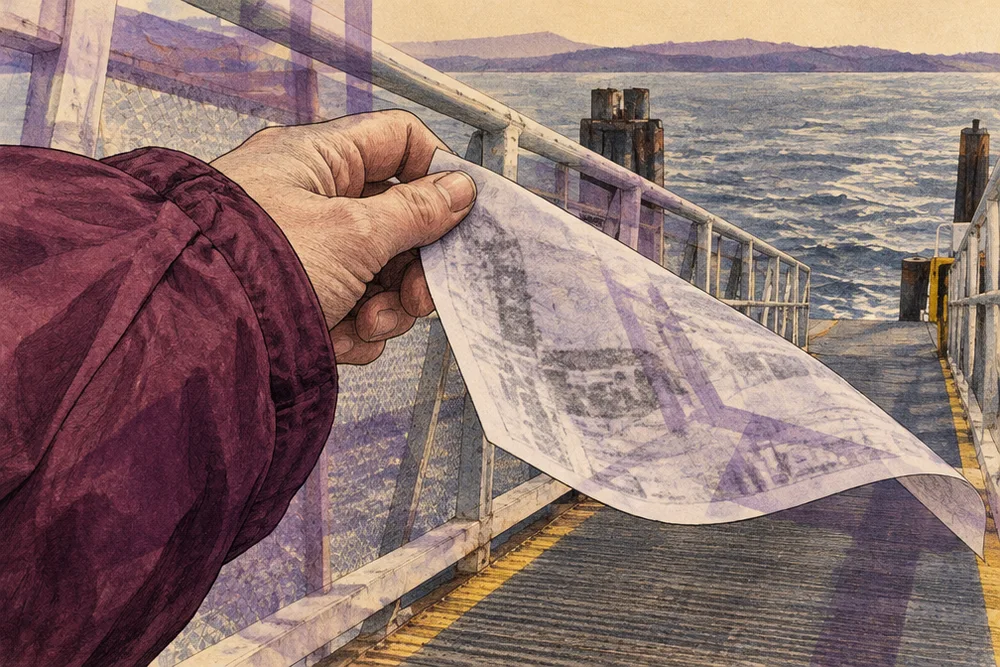
On the ferry Pippa stepped heel-first over the raised sill into the shelter. There was room on the bench for both of them if Rafe sat with his knees turned. He stayed up until she had her bag on the paper. It was a photocopy of the visitor directions, with a little square in the bottom corner for a map. In the square, someone had drawn the school as a single block.
“They’ve called the cycle yard ‘the west courtyard,’” she said.
“Have we got one of those?”
“Apparently we’ve had one this whole time.” She took the yellow pencil from behind her ear. “I’m meant to tell them if anything’s unclear. They want the directions ready if they sign off the gate.”