The Way Back to Bell Street
Page 154 of 227
Chapters
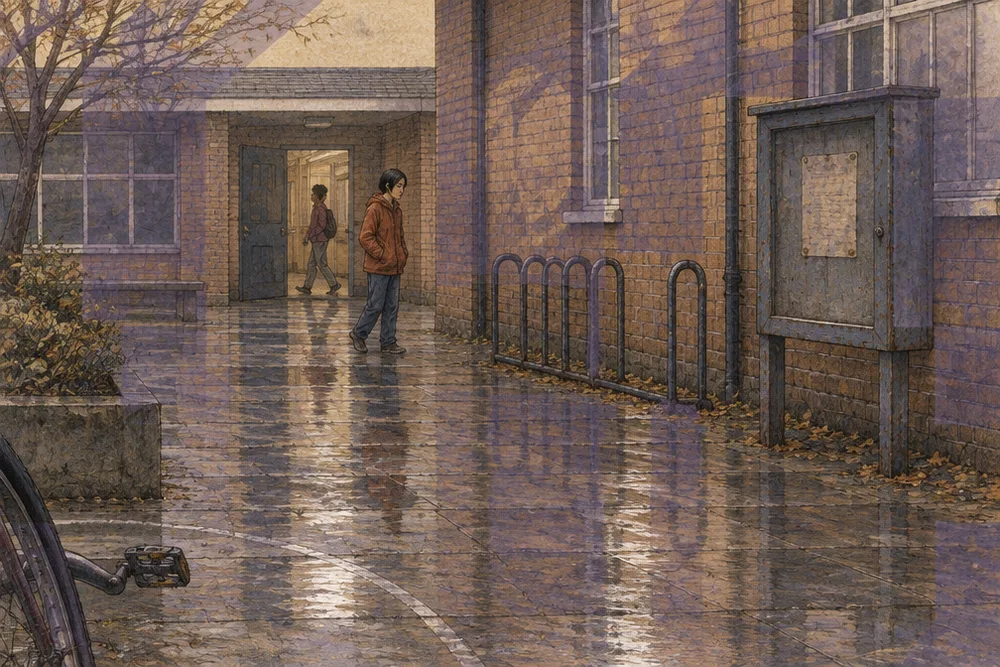
Outside, the yard had changed without changing at all. The rack still stood in its old place. The cabinet still held a faded notice about a meeting that had happened months ago. A bicycle pedal still crossed the chalk arc. But now the school had agreed to remove one rack for a test, store it rather than destroy it, and let the route fail if it failed. That was not the opening of Number Six. It was a way to find out whether opening it would cost somebody else their way through the yard.
Rafe found the pupil by the corridor doors, waiting while a friend adjusted a bag on the back of the chair.
“They’ll fund a reversible trial,” he said. “One rack comes out. They’ll mark the new layout on a busy day and test it before the room opens. If the turn doesn’t work, the door stays shut.”
The pupil looked at him. “Who’s moving the rack?”
“Maintenance. With the cyclists there.”
“Who’s checking the turning circle?”
“You, if you’re still willing. One scheduled test, not every day.”
“I’ll see what the date is.”
Rafe nodded. He had almost said thank you for the help. It sounded too much like he was thanking them for lending their body to his project. He said instead, “I’ll get the date to you directly.”
“You’d better.” The pupil’s friend opened the door. The chair moved through, and Rafe stepped back to give it room.
He crossed the yard to the cabinet. There was a small brass label on its side, nearly hidden under old tape. He peeled away the tape without taking the label off. The cabinet was still in use in the narrowest sense: it held a spare key for a notice board, a tin of drawing pins, a map of the school with a corridor that no longer existed. There was no reason to pretend it had to stay where it was.
The thought did not make moving it cost nothing. He pictured the person who had put the map there, the person who needed the pin tin, the cyclist who would lose a familiar rack, the pupil who might still find the turn blocked. A workable entrance would require all of them to adjust. No single adjustment proved the whole plan just.
He folded the tracing beneath his arm and went to find the cyclists who had offered to help.
They were waiting beside the rack. The long-frame cyclist had one hand on the handlebar and the other on a lock looped through the front wheel. “We’re not saying yes to losing a rack,” they said. “We’re saying we’ll look at the layout.”