The Way Back to Bell Street
Page 14 of 227
Chapters
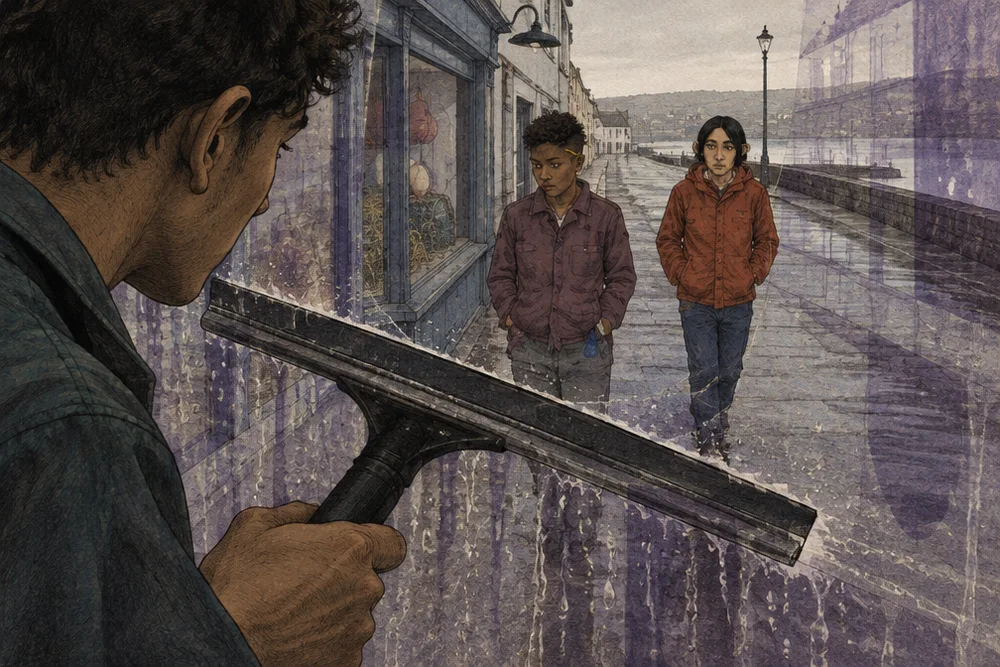
The air outside smelled of diesel, salt and wet stone. Pippa set off toward the school end of town, walking heel-first with her elbows tucked close, the blue tag knocking against the bell in her pocket. Rafe followed at her shoulder.
“You said we’d ask someone else,” he reminded her.
“I did.”
“So ask.”
“I don’t know who.”
“The person with the biggest memory of the place?”
“That isn’t how memories work.”
He kept pace with her along the quay. “You have an answer for everything except why you’re going across the bay.”
“That’s because you keep asking the question I’m not ready to answer.”
“I can ask something different.”
“You could.”
There was no warmth in it, but no door slammed either. Rafe held onto that distinction as they crossed from the quay toward the school road. The bell pressed a square outline against Pippa’s jacket pocket. He wondered whether it could ring on land, whether its strange note had anything to do with the ferry at all.
At the corner, a man in a flat cap was cleaning salt from the lower windows of a marine supply shop. A long-handled squeegee rested against the wall. His gray hair was clipped close and his hands moved with the unhurried precision of someone who had repeated the same job through many seasons.
Pippa slowed. “Do you know where Bell Street used to be?”
The man set the cloth down. “Depends which part.”
“Number Six,” Rafe said. “A house with a front room. We’re trying to work out where it stood.”
The window cleaner studied them, then the bell-shaped bulge in Pippa’s pocket. “You’ve got a reason, then.”
“We’re carrying a lost-property bell,” Pippa said. “That’s the reason we’ve got.”
He gave a quiet laugh. “I’m Tom Arlen. I cleaned the windows along Bell Street before the council pulled it down. Not that I was old enough for the whole run. I was an apprentice then.”
“Do you remember Number Six?” Rafe asked.
“I remember the view from it.” Tom glanced beyond them, toward the bay. “Or, more precisely, the view from the step outside.”
Tom pushed the shop door open with his shoulder and fetched a small folded cloth from inside. He wiped his hands while he spoke, as though he preferred to finish one task before taking up another.
“The street sat lower than this road,” he said. “Houses close enough that you could lean out and pass a cup to your neighbor. Number Six had a parlor window that looked down toward the water.”