The Tide Skips a Beat
Page 26 of 285
Chapters
Nivan could ask them. Then their names would be in the board’s hand, or in a reporter’s notebook, or in a landlord’s complaint. He had only just learned how quickly one man could become the explanation for a whole street. He went back to his room without knocking. His work invoices were bundled beneath his spare clothes, in the flat tin case he kept dry even when the rest of his kit got soaked.
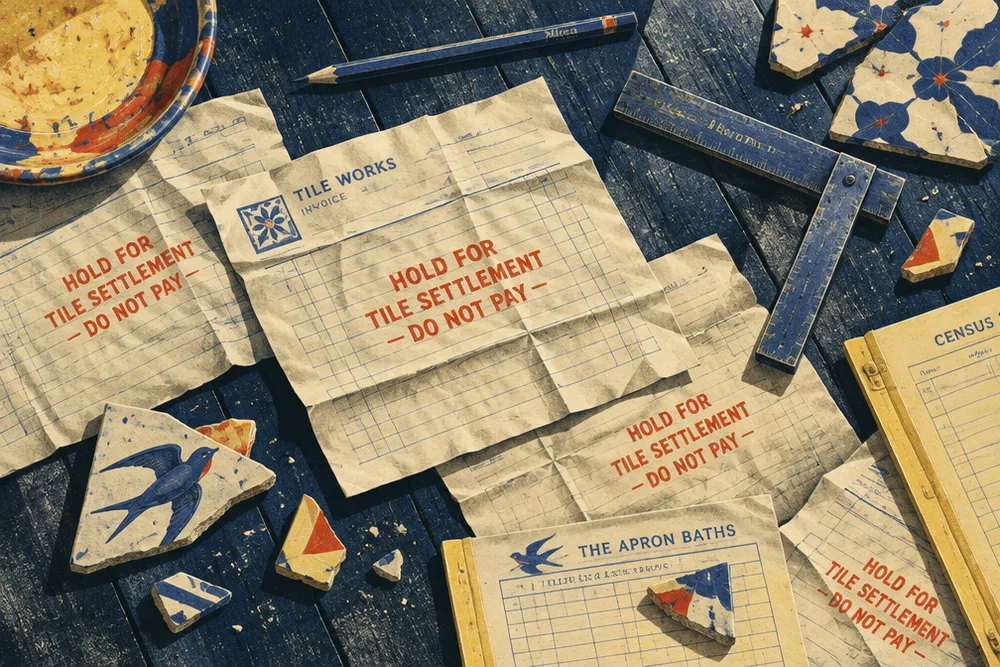
The invoices came from three contractors and six weeks of small jobs. Nivan had saved them because laborers were paid late, and because an unpaid promise was easier to argue when it had a date and a stamp. He spread the sheets on the floor, weighing their curled corners with tile scraps. His handwriting ran tight beside each job: grout, threshold, rehang, rib finish. The names of buildings formed a route across the block and beyond it.
At first he searched for the silence mark. It appeared on his own work order, sketched beside the words finish surface, no census entry. The line had been added in another hand, in red grease pencil. He found it again on a job at Cinder Steps, then on two converted lofts near the old rope market. Each order had the same instruction: keep the new rib below the visible cut; do not call for a cutter.
The phrase made his skin tighten. He could hear the foreman who had hired him: “You’re a tile setter, not a clerk. Make it neat and get paid.” Nivan had done both. He had set tile around the new door, smoothed the edges, and never asked why the rib had been carved if nobody wanted it counted.
He checked the dates. The jobs had followed one another in batches, each after a conversion permit. Some invoices were addressed to property companies; others to a contractor who had paid him in coin. Yet the red note was copied exactly, even down to the hooked tail on the last letter. It was not a single foreman’s habit. Someone had made a rule and sent it down the line.
He took a scrap of paper and copied the work-order phrase. Then he stopped. The invoices carried names and flat numbers. Even if he could prove the instruction, passing those pages to a stranger might expose the tenants whose homes he had worked in. Miren Dask had been a stranger when she watched the tide fail, but she had stood between the neighbors and the board’s blame. He remembered her vermilion pencil and the way she had asked what he saw, not what he had done.