The Tide Skips a Beat
Page 242 of 285
Chapters
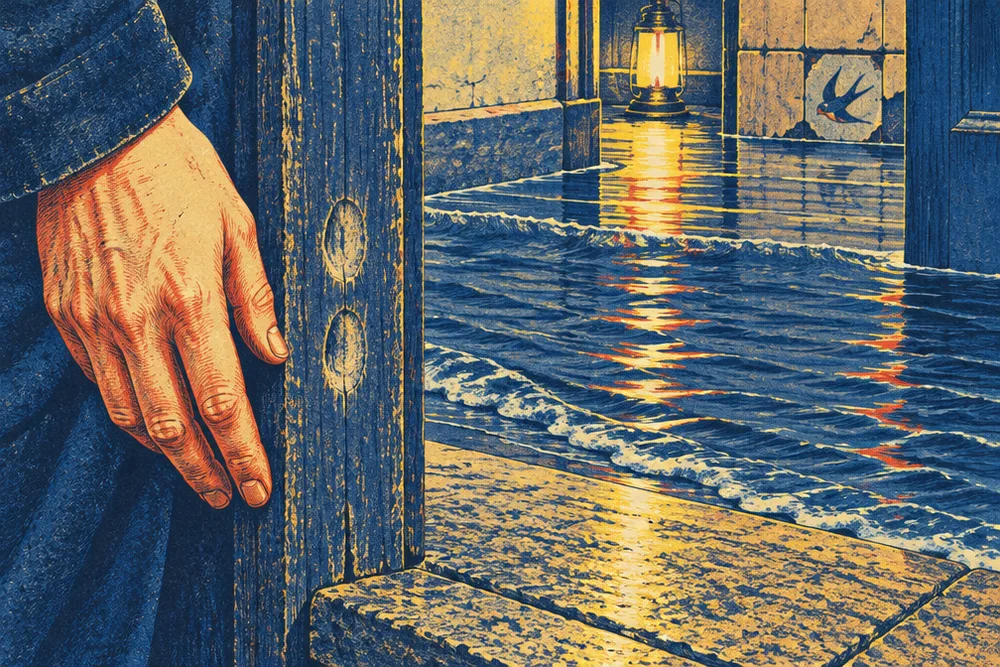
Nivan raised his hand to the rib beside his entrance. The two oval scars were shallow, their edges worn smooth from use. He had once copied his neighbors’ taps because that was what everyone did at dusk. He had not known his door had been left out of the count, or that a copied rhythm could stop a whole tide. Now he could see the difference between repeating a motion and being included in what it meant.
He tapped twice. The sound was small beneath the answering block. His fingers stayed against the rib a moment after the second knock, as if it might be useful to feel whether the pattern had passed through the wall.
At the low end of Needle Row, the tide rose from the dark seam. Indigo water crossed the first paving groove and spread around a drain. It climbed to the mark where it had stopped on the day Nivan moved in. People who remembered that evening leaned forward, looking first at the water, then at his hand.
It did not halt.
The front advanced past the old stopping point, indigo spreading in a steady sheet between the buildings. A woman on a landing let out a breath that turned into a laugh. Someone else tapped the frame again, too late for the count, then lowered their hand.
Nivan stepped aside as the tide reached the base of his threshold. Detached droplets lifted from the surface and drifted toward the nearest shell, catching the primrose lamps overhead. The water followed the new branch, not the old shortcut. It passed his door without hesitation and kept going uphill.
Miren’s gaze stayed on the moving front. She did not smile yet. Nivan understood that she was waiting until it became more than a promising first stretch of street.
The crowd began to move with the tide, but the witnesses at Seam Walk had been told to hold their positions. Nivan went with Tavi and the clerks along the numbered sight windows, where the service walk ran beside the water’s route. He stooped under the first low lintel. His knotted hair brushed the stone; the square gauge at his hip caught once on a latch, and he freed it without stopping.
At each window a witness read the level against a primrose notch. Another marked the time on a slip. A third compared the water’s position to the leaf’s branch. The method had been agreed in public and practiced on dry runs. There was no single person who could say the tide had reached a place simply because they wanted it to.