The Tide Comes Through in Color
Page 97 of 268
Chapters
Quilla let her breath out through her nose. Ninian had taught her not to read the passengers’ faces as answers. He had stood in the booth the first night they managed a full forward showing, brass counter dull in his palm, and told her that a person could be frightened, angry, tired, or all three at once. The counter had clicked when he squeezed it. He had not looked at the screen for long.
The woman turned to the child and spoke. The girl shook her head. She moved toward the counter, where a loaf had been left to cool. Her mother blocked her with one forearm, not harshly but without giving ground. The girl said something else. Her mother answered, and this time Quilla could see the impatience in the set of her jaw.
The woman finally picked up the slate. She wrote, THE BREAD IS FOR UPSTAIRS. Then she held it up. The block letters were blunt and steady. The child leaned around her hip to see Quilla’s face.
Quilla read the words twice. Upstairs. Not a room remembered from the old street, not a temporary refuge. A place that had stayed inhabited long enough to have bread sent to it. The bakery woman put the slate down and turned to check the oven. The clock continued to tick forward. Quilla watched its hand pass the mark she had memorized.
She had wanted one proof that Tressa had survived. The screen was giving her a life instead, and she did not yet know what to do with it.
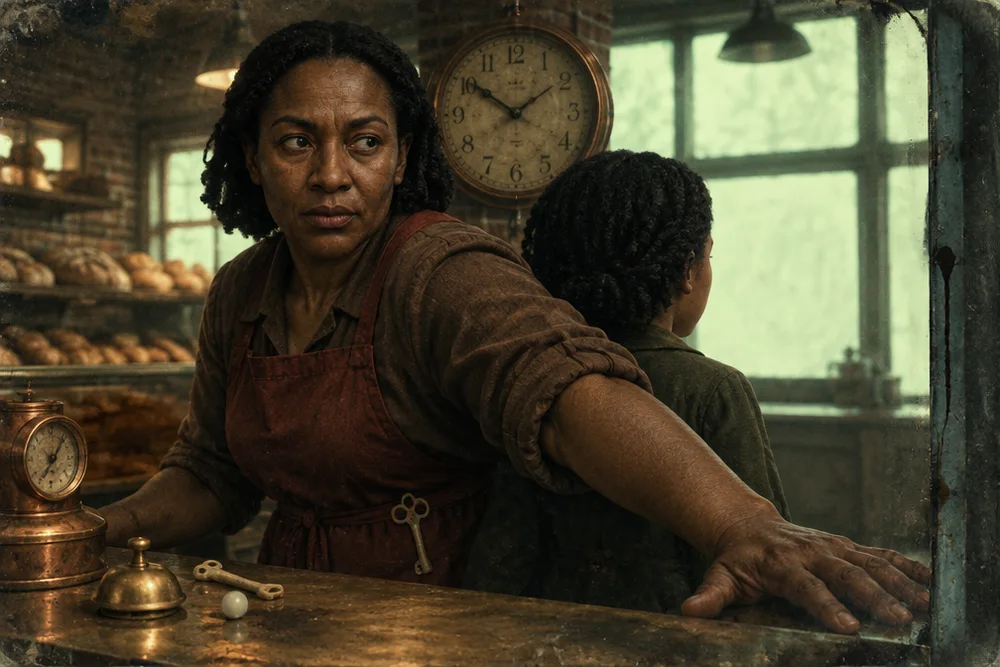
Ninian had set up the exchange himself. He’d bolted a narrow shelf beneath the booth window and made Quilla practice passing a slate without leaning beyond the sill. “We’re not going to touch,” he had said. “Not today.” She had answered that she understood. He had watched her hands, not her face.
Now the woman cleared a place on the bakery counter and put the loaf there. She wiped a little flour from the slate with the side of her thumb. Quilla wrote, MAY I ASK YOUR NAME? and raised it.
The woman’s left cheek dimple showed when she frowned. She glanced at the child, as if checking whether she should be included in the answer. Then she wrote: TRESSA. FEN. Her hand paused between the names. Under them she added, WE HAVE WORK.
Quilla felt a sting behind her heavy eyelid. She blinked it away, then wrote: I’M QUILLA. Her fingers cramped around the chalk. She had imagined saying her own name to Tressa for years. In that imagined scene, Tressa had been small, wet, frightened, and waiting to be lifted. The woman across the seam was dry, busy, and deciding what she owed a stranger.