The Tide Comes Through in Color
Page 65 of 268
Chapters
Bea nodded, as if marking a small point in a ledger, and went toward the ticket office. Her steps sounded firm on the auditorium boards. At the door she paused.
“If the child is who you think she is,” Bea said without turning, “she’s still a person on the other side. Not a picture you get to rescue because you’re sorry.”
The door clicked shut behind her.
Quilla stood alone in the room with the stopped projector and the flour. She heard the word sorry in Bea’s voice and tried not to hear it in her own.
She returned to the booth and released the feed tension exactly as she had promised. The machine was warm beneath her hands. The dark strip waited in its path, a sequence of frames held fast by sprocket teeth. Quilla checked the rollers, then the film edges, looking for a crease or a torn perforation. The loop had not slipped. The spill had not been a mechanical accident.
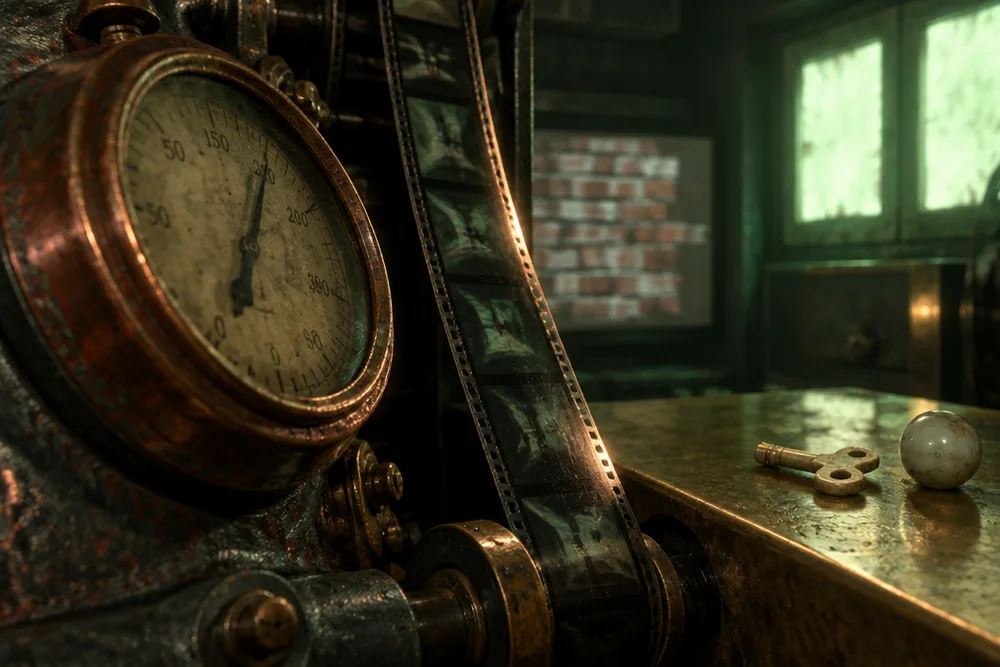
On the image she remembered, the baker’s arm reached in from the right. The adult’s hand moved toward the small figure, not away from it. Quilla had taken that for shielding, though she could not be sure. The tray might have been the only thing between the child and the opening. The adult might have been reaching for the child, or for the tray, or for something Quilla could not see.
She rubbed the red line in her palm. The pressure of the gauge had faded, but the skin held the shape of it. She understood the mechanism now in one narrow sense: at the overlap, the screen could carry something through. She did not understand what made the shelf cross, or how much more could follow it. She did not understand what happened to the child when the image moved backward, or whether the child had noticed the audience at all.
The projector’s metal casing ticked as it cooled. From below came the brisk drag of a brush across velvet. Bea had not waited for Quilla to offer help. Quilla could hear her working through the first row, seat by seat, restoring the room to a version of itself that had not been touched.
She set the copper gauge on the workbench and wrote down the test’s details. Reverse feed, bakery shelf, seat-back alignment, tray displacement, flour in auditorium. Then she added: adult present, child behind, not approached. She stopped with the pencil poised above the paper. The last statement was true only in the narrowest sense. She had not crossed the room. She had leaned for the child. She had let Bea pull her back.