The Tide Comes Through in Color
Page 57 of 268
Chapters
A loaf rolled backward along the board, returned to its place as if the shelf had tilted uphill. Flour lifted from a cloth in a soft pale drift. The screen’s fixed salt stain cut across the bakery wall. Quilla used it to judge whether the image was shifting or the frame itself was moving. The stain stayed put.
“You can stop it now,” Bea said.
“I want to see whether the shelf holds.”
“It’s a picture.”
“The picture has touched us before.”
“It has dropped flour on a seat,” Bea replied. “That doesn’t mean you put your hand in it.”
Quilla let the reverse feed run. The shelf’s iron brackets crossed the screen’s bottom edge, and a shallow tray appeared on it. She saw the tray before she saw what sat inside. A metal rim, a fold of cloth, a bright glint like a wet coin. The bakery behind it shifted by inches while the shelf held steady against the seat backs.
“That’s enough,” Bea said.
“One more second.”
“No.”
Quilla’s finger tightened on the lever. She had not intended to argue. The word came out of her anyway, joined to all the other words she had used to keep the test alive: soon, just once, almost there. The picture had brought the shelf nearer. She could feel the promise of it as clearly as the pressure of the copper gauge in her palm.
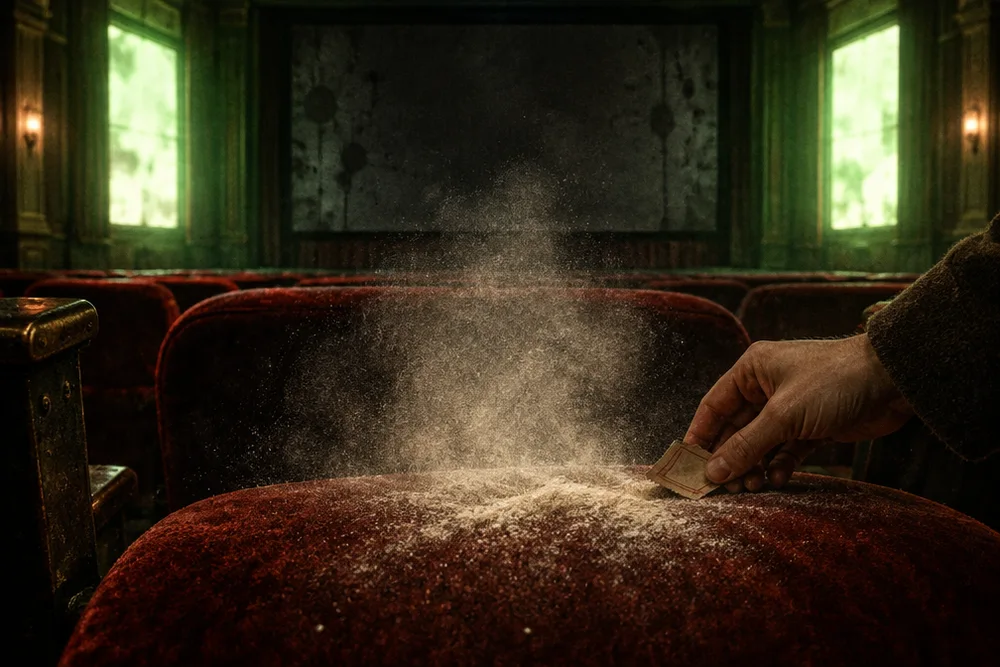
Then the tray jerked. It did not fall out of the screen. It slid off the shelf and struck the image’s lower edge, where the frame seemed to catch it. A cloud of flour burst upward, spreading across the projected bakery and, at the same instant, falling into the front row.
Bea snapped her ledger closed and stood. Flour sifted over the velvet seat, pale on dark. Some struck her coat sleeve. She reached for the aisle rail with her good hand.
Quilla pulled the stop lever. The projector rattled down, the reverse loop clattering through the rollers before it went still. For a moment the image remained on the screen—a shelf, an empty place where the tray had been, a baker’s arm just entering from the right—then the lamp went dark.
Bea looked at the flour on her sleeve. “That’s a consequence.”
“It’s flour.”
“On my seats.”
“I’ll clean it.”
“You’ll clean it after you tell me why you let it reach the row.”
Quilla descended from the booth by the uphill entrance, taking the narrow stair two steps at a time. The auditorium smelled of dust, warm metal and fresh flour. She reached the front row as Bea was brushing the powder from the seat with a folded ticket stub. It clung to the velvet in a soft, stubborn film.