The Tide Comes Through in Color
Page 50 of 268
Chapters
Ninian came to the booth window. “Bea, stay behind the rail.”
“I am behind the rail.”
“And don’t move toward the screen.”
She looked at him. “I told you I wasn’t climbing into it.”
“I’m reminding you.”
The image continued backward. A baker’s hand reached toward the counter. A flour sack slid across the floor and rose to the shelf. In the booth, the guide roller turned, quiet and true. Ninian had wanted a stable feed. He had got one. Now the machine was doing what they asked, and he felt no closer to knowing what he had promised to do when it answered.
“There,” Quilla said. “The number.”
She eased the speed down. The projection stuttered once, then settled on the painted bakery sign. A line of black digits crossed its lower corner, small but legible. Bea stood very still. Her face held no recognition Ninian could read, only the effort of looking without reaching.
“That’s his,” she said. “That’s the number from the tin.”
“Do you know what it means?” Ninian asked.
“I know it was on his ferry ticket.”
“It could have been written there for any reason.”
“It was his number.” She did not raise her voice. “You don’t have to make it mean more than that. I’m asking you to let me see it.”
Quilla stopped the image. The light stayed on the frozen sign. Ninian looked at the reverse switch, then at Bea’s hand on the ledger. He had marked the trial in his head as a way to test the feed, not to show anyone proof. It was too late to pretend that distinction mattered.
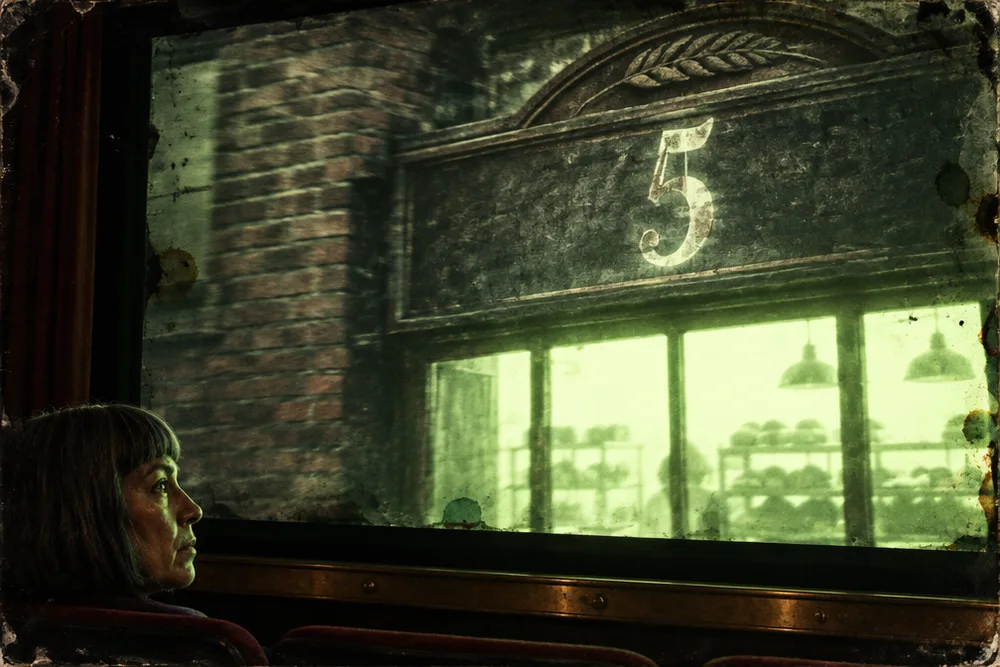
“One minute,” he said again. “We run the full street backward. If the picture starts to fill the screen, I cut power. Nobody leaves the rail.”
“Understood,” Bea said.
Quilla did not look away from the sign. “I’ll watch for the edges.”
“You watch the screen,” Ninian said. “I’ll watch the machine.”
“I can do both.”
“You’ll do one.”
She turned to him. “If it gets to full-width overlap, I’ll pull Tressa.”
He heard the words exactly. He also heard the quiet assumption under them: the screen would open, and she would have time to choose what to take. His block-letter stop instruction, his mark on the paper, had become a cue in her mind—not the instant to end the test but the instant to reach for her sister.
“That is not what the mark means,” he said.
“I know what you wrote.”
“You think it means then.”
“It means I have to act before the chance closes.”
“The mark means cut before the screen fills.”