The Tide Comes Through in Color
Page 31 of 268
Chapters
Quilla leaned closer, trying to make out the building seams. “How long would it take to rebuild a landing?”
“Depends on what was left standing.” Ninian spoke as if the answer might be found in the image’s masonry. “Depends who needed it.”
“That’s not an answer.”
“It’s the only one I have.”
The child reached the lower end of the street. She set the parcel down on a rail post and shifted her grip, then continued toward a pale opening where the harbor ought to be. The screen showed no water, only a blank brightness bordered by the dark walls. Quilla’s eyes moved between the repaired boards, the changed slope, and the child’s sure feet.
“She’s not trapped in the flood,” she said.
Ninian’s mouth tightened. “We don’t know what she is.”
“You saw the street. You saw her.”
“I saw a picture.”
“You heard the people.”
“I heard something at low tide. I have heard it for thirty years.” His voice dropped. “I’m not telling you it was a picture.”
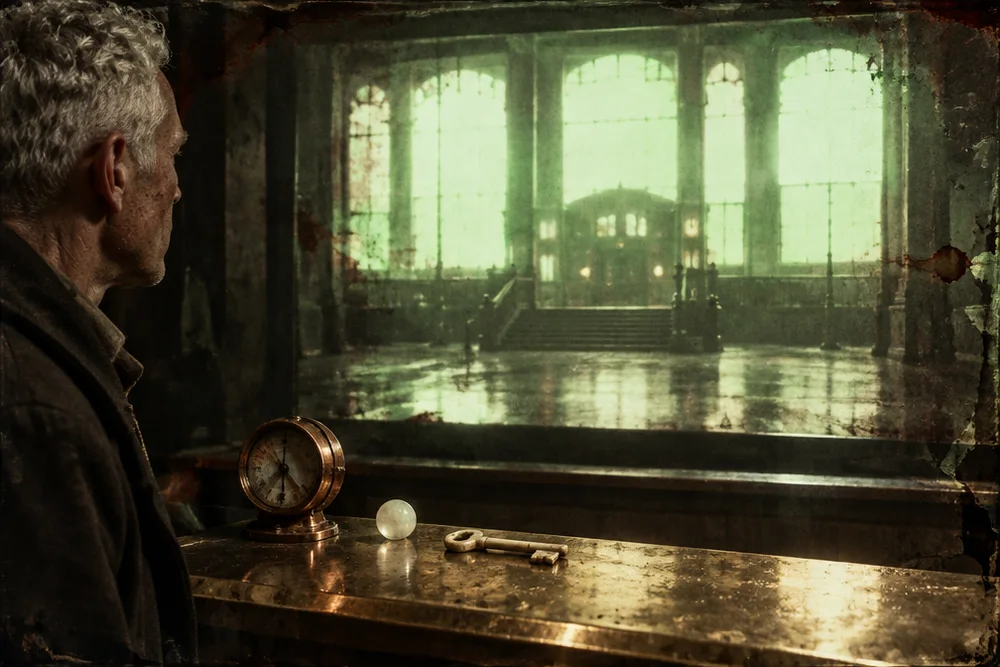
Quilla looked at him. His fingers were closed around the passenger counter, the brass worn smooth where his thumb had worried it over the years. He watched the screen as if expecting it to accuse him. She wondered how many times he had stood by the harbor listening for a voice he could not name.
The child was gone from view. The baker remained behind the counter, wiping a streak of flour from the table with the heel of her hand. Quilla waited for the screen to give her something else, a glance or a gesture, but the woman turned away to reach for another tray.
“We need to see the landing from the other direction,” Quilla said.
Ninian shook his head. “We need to know what this reel does before you decide it can carry you anywhere.”
“That’s why we’re testing it.”
“You’re testing it with your whole life already decided.”
Quilla stopped the machine and let the reel settle. The projector clicked as the film cooled. On the screen, the bakery faded to a dark stain that seemed to remain even after the image was gone. The screen always kept its marks in the same places; the projected brick moved, but the stains did not.
“I need to know whether the footage can be reversed,” she said. “The child went toward the landing. If I can run it backward, I can see what happened there.”
“You can make the image move backward.”
“That’s what I mean.”