The Tide Comes Through in Color
Page 154 of 268
Chapters
Quilla kept her hand near the feed. Ninian stood beside the projector, listening to its rhythm and the tighter, faintly strained note of the reverse loop. Bea remained below, one hand on the back of a seat.
“Nothing’s happening,” Bea said.
“We haven’t started the overlap,” Quilla replied.
Ninian turned the crank. The footage reversed. A baker’s sleeve slid backward across the frame. A shutter lifted the wrong way; the image on the screen seemed to fold toward itself. At the outer edge, the bakery wall met a narrow strip of the auditorium’s brickwork. The two surfaces did not match. For a moment, the projected wall doubled, then pulled level with the cinema wall behind it.
“Stop there,” Ninian said.
Quilla’s fingers closed on the control. The picture shuddered but held. At the far left edge, mortar shifted. A dark line opened where the screen and wall met. It was no wider than a thread, but the green in the image dimmed around it. Ninian heard water, not in the projector, not in the street below, but behind the brick.
“There,” Ninian said. His voice came out too loud in the booth. “That’s the seam.”
Quilla leaned toward the screen without stepping out of the booth. “Is it water?”
“It’s the harbor.”
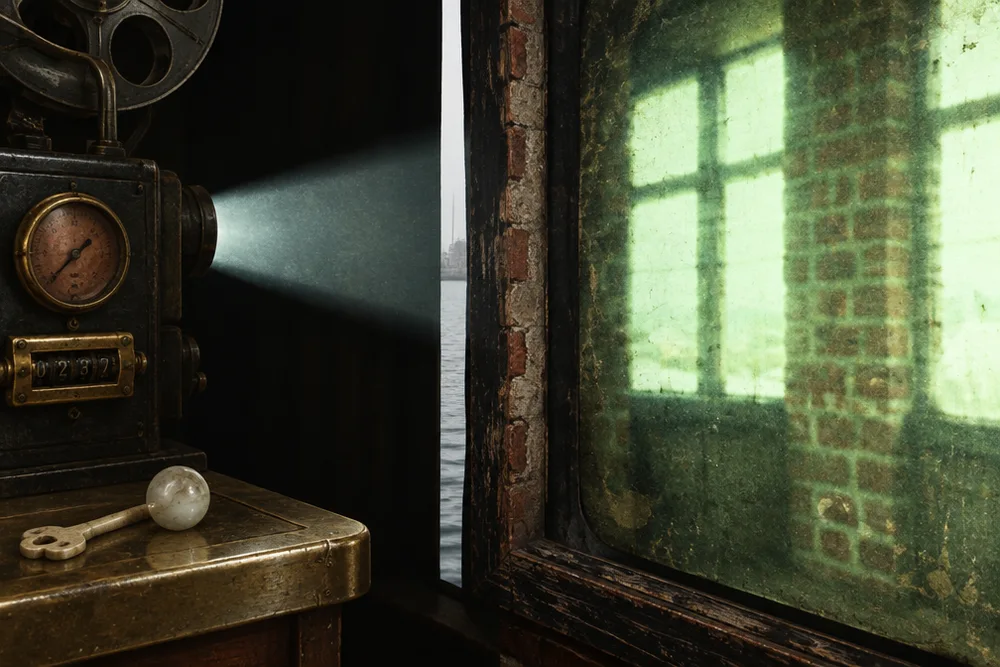
The dark line broadened, and through it showed a patch of moving gray that belonged to no street or wall. A tiny pulse of light crossed the surface. Ninian knew how water looked from a ferry deck in the hours before dawn. He knew its quiet promise of depth. His hands tightened around the projector’s metal casing.
“Cut it,” Bea called. “Now.”
Quilla stopped the crank. The image trembled on the screen. The dark seam stayed open.
“The lamp,” Ninian said.
“The lamp doesn’t close it,” Quilla said, but her hand went to the switch.
He had already reached for the lever. It was the old reflex, simple and decisive: darkness would stop the picture, and a stopped picture might end the call. His hand hovered there, a finger’s width from the switch. A faint wash of seawater smell reached the booth. Below, Bea backed away from the screen.
“Ninian,” Quilla said. Her eyes were on his hand, not his face. “Don’t.”
He pulled back. The lamp remained on, the shutter trembling in its housing. The question inside him had been waiting since the night he ferried the passengers to Wick Row. He had never given it a name that did not sound like a duty. Now, with the harbor visible through displaced mortar, he could not pretend he was only checking a slope.