The Tide Comes Through in Color
Page 14 of 268
Chapters
He had made himself an answer once, thirty years ago, and carried it for so long that it had begun to feel like a fact. He looked at the drawn shoreline, then at the blank beyond it. “No,” he said again, and started to close the door.
“There was an outer post,” Quilla said.
The door stopped moving.
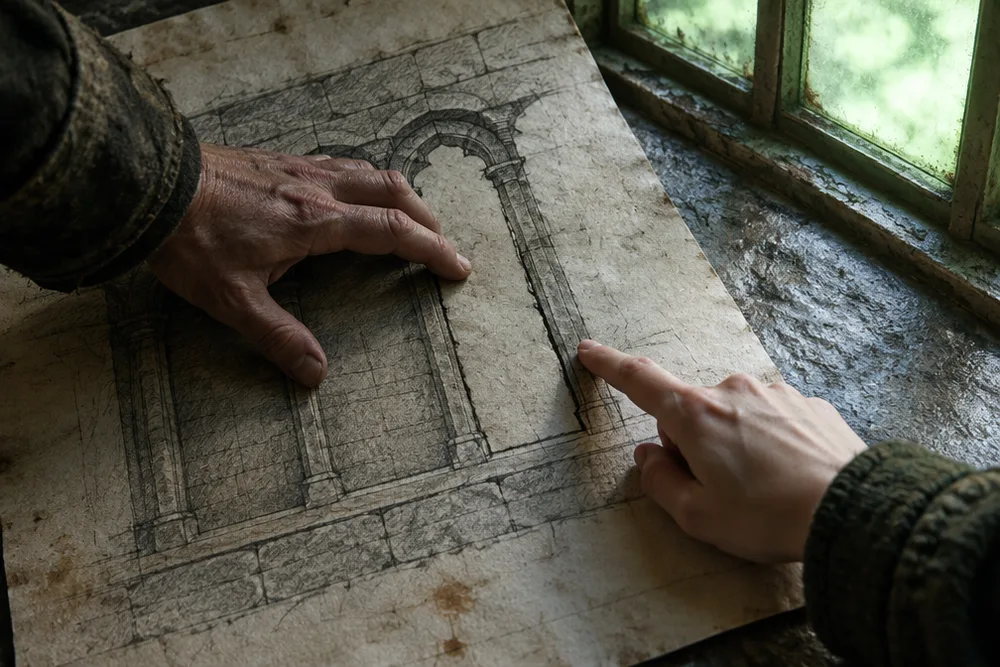
She flattened the drawing against the sill. The landing’s near rail was marked with two uprights, but the outer edge ended in the blank patch she had shaded. “I thought maybe the drawing was incomplete.”
“You didn’t draw it.”
“I copied what I saw.”
Ninian opened the door far enough to take the paper. “Where did you get this?”
“From the screen. I stood in the booth and watched.”
He pointed to the edge of the landing. “There. The post was a little taller than the inner rail. Split down one side. I knocked it with the ferry hook every time I brought a boat in.”
Quilla took the paper back. “It isn’t there now.”
“It was there on my last crossing.”
He heard the sentence only after it had left him. The taste of it came back: salt on a raw lip, rain driven under a collar, the ferry’s engine shuddering in its mount. His hand had been on the outer post. The landing had been crowded, a line of wet people waiting to step ashore. Then the tide had pulled hard beneath the boat, and the post was gone the next time he looked. He had counted heads and taken them up the stairs. He had never gone back to Wick Row.
Quilla’s eyes sharpened. “When was your last crossing?”
“Thirty years ago.”
“That’s when the flood came.”
“I know what year it was.”
“And the street in my screen is the landing after that?”
He folded the drawing once, exactly down its center, and gave it back. “I said I wouldn’t help.”
“You can say it again when you’ve looked at the reel,” Quilla said.
“I don’t need to.”
“You recognized the landing.”
“I recognized a post that isn’t there.”
She pulled the paper against her chest. “My sister was eight. I was sixteen. I lost hold of her in the water. If she’s alive in that picture, I’m not walking away because you don’t like the view.”
“And if she isn’t?”
“Then I’ll know.”
“You think knowing is a harmless thing.”
“No.”
That answer made him look at her. She had set her jaw, but there was no brave shine in her eyes, no expectation that the world would reward her for wanting something. Only an old need held tight. Ninian recognized that too, though he had spent thirty years calling it a different name.