The Soundcheck Before Monday
Page 68 of 165
Chapters
Rhea shut the laptop lid without touching the playback controls. She had not agreed to erase anything; Mina had to be part of that decision, and the file had implications beyond Rhea’s. But the lid kept its sound inside for the moment.
On a clean sheet, she wrote: No recording. Anyone may stop. Notes only by approval. Explain before the doors open. She stared at the words and saw the holes in them. Who would hold the card? What counted as approval? Could a person retract an official quote after others had heard it? The paper did not answer. It was only a start.
She took the sheet downstairs, where the auditorium’s double doors opened onto the lobby. The stage beyond was dim except for the work light over the first row of chairs. A tangled coil of cable sat on the floor near the wall, left from Friday. Rhea stopped before it, imagining a conversation that did not depend on the recovered file being heard at all.
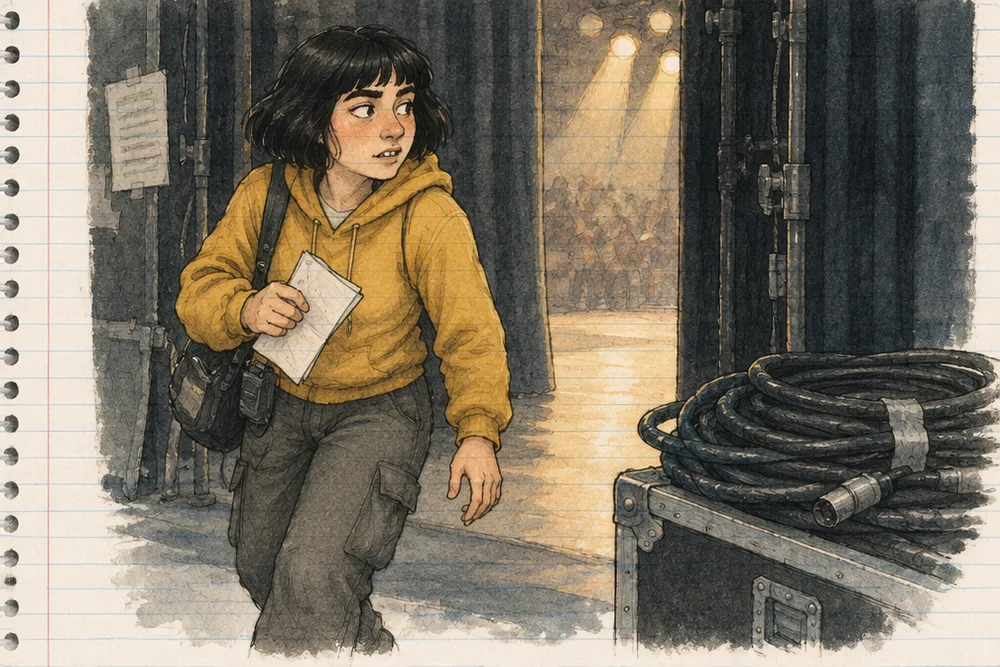
That would mean asking the people involved to make new choices in front of one another. It would mean they could decline, object, or walk away without Rhea supplying their reasons. It would mean the assembly might not produce the tidy reconciliation Principal Saye wanted. The audience might leave with an unresolved objection and a schedule still to be decided.
A quiet audience, Saye had said, was a sign people were listening. Rhea had never thought to ask whether quiet could mean that people had given up trying to be understood. She had heard the Friday voices change when the approved speeches fell apart, heard the pauses where someone could have taken back a sentence and did not. But she could not use those pauses as proof that anyone wanted them replayed.
She put the page on the nearest chair. The paper curled at one corner in the draft from the lobby. Rhea smoothed it with her palm. Her own handwriting looked too certain. She added a question mark after “Anyone may stop,” then drew a line through “anyone” and wrote “any person in the room.” The distinction was small, but captains were not the only people at risk of being quoted.