The Saltwind Switchback
Page 74 of 175
Chapters
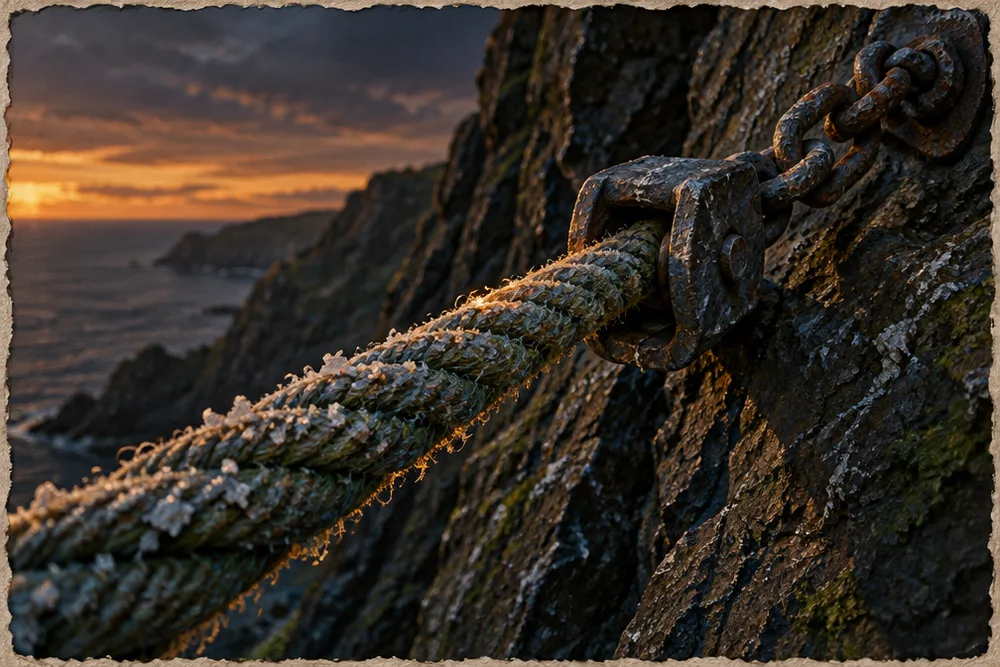
The pocket had no ring, no iron cheek plates, nothing to keep a cable from sawing against the stone. Tamar uncoiled the short length of chain she had carried from the saddle and threaded it through the hollow. The links scraped and clinked softly. She pulled them back against the inner wall, then leaned her whole weight into the loop. Nothing moved. She eased off, checked for fresh powder at the lip, and tried again with a stronger jerk. A thin salt flake broke from the outer edge, but the stone behind it stayed fixed.
The first line had been sized for the quarry’s direct span. She could not simply drag it across the new angle; the old run would pull hard against the pocket’s edge and twist the basket sideways. Tamar unpinned the guide block from her belt and set it in the chain loop. She turned the block by hand, listening for grit in the axle. A little brine had entered its casing. She wiped it with her sleeve and rotated it until it ran freely. Then she led the line through and sent the loose end back toward the saddle, hauling until the fiber lay straight.
It took three trips along the connecting ledge to bring the necessary pieces within reach. On the first, she fetched the spare shackle. On the second, a coil of thin signal cord and a wedge of hardwood. On the third, she returned with the line’s free end. Each time she backed away from the edge rather than turn on it; the ledge narrowed where the salt skirt had eaten into the rock. Her boots found the same shallow notches on every pass. The lower crossing had trained her to move with a load. This passage demanded she move without pretending a load was the only danger.
She made a temporary hitch through the pocket, then fixed the guide block to it. A shorter length of line could now run from the saddle to the pillar, at a sharper angle than the failed direct span but with no need for the vanished east winch. She worked the knot flat, dressed every turn, and marked the standing part with a smear of dark grease. If the mark moved, the hitch was slipping. She would see it before the whole thing came loose—if the lamp held, if the haze cleared, if she remembered to look.