The Saltwind Switchback
Page 53 of 175
Chapters
She set the diagram aside and climbed toward the pale bulge, stopping short of its slope. The nearest heel scar had been carved into the harder dark seam beside it. She could see how a person would pass: back to the wall, feet on the seam, fingers in shallow cuts. No person could carry the tray there. Perhaps even an empty carrier would be too much.
The familiar landing lay below the bulge. If Tamar could reach it, she could lower the gondola onto the old freight fixture and haul it up the other side. It was the obvious route, written into her hands by years of work. She had set the stop lengths, tightened the bolts, ordered crews through that notch. Her shoulders leaned toward it before her judgment caught up.
The landing’s outer edge moved.
It did not crumble all at once. A thin white layer peeled from the wall, lifted as if caught by an invisible hand, and broke into a sheet of flakes. The freight fixture went with it. Iron scraped stone, then struck the flood. The platform sagged, twisted, and slid downward in a slow, sickening arc. For a breath, its old anchor pockets showed behind it: dark, square cuts in the rock, hidden beneath salt crust for years.
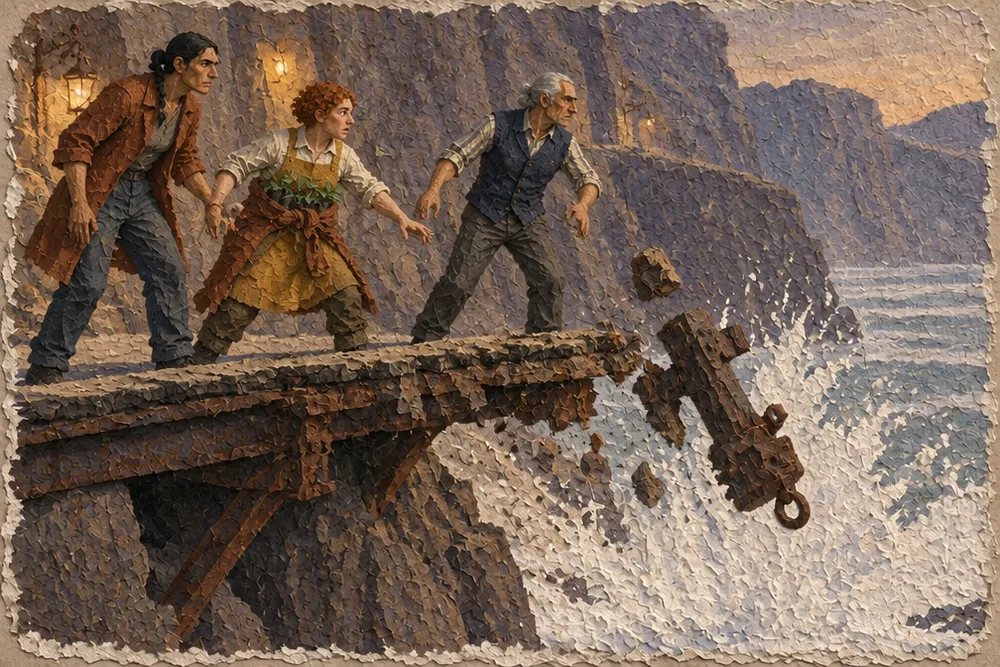
Then the platform vanished under brine. A plume of chalk-white water rose and collapsed. The current carried away a length of rail. Tamar pressed herself to the wall, feeling the shelf tremble beneath her boots. The salt bulge continued to shed tiny grains, pattering against her sleeves and collecting in the crease of her palm.
She had not been standing on the landing, but the route she had chosen for the gondola would have put it there. Her grip tightened on the wall until her knuckles hurt. The old cuts were not proof that the landing had been sound. They were proof that the anchor had once been set into rock. She had seen the fixture fail and called every place beyond it the same danger.
A gust swept the last flakes down. Tamar backed away from the sloping crust and returned to the notch. Her work had trained her to look for movement in a load, strain in a line, a shift in a wheel. Here, the wall itself moved too slowly to notice until it came apart. She would have to trust old marks made by people escaping, not the platform built for freight.