The Saltwind Switchback
Page 2 of 175
Chapters
“Now it’s a bolt.”
She set the wrench down. “The cart should be here.”
“It should.” Vasko leaned his weight onto one hip. He had a way of making silence sound like a tool laid out for use. “Road’s dry at the bend?”
“It was dry when I came through.” Tamar checked the winch, then the cable’s west anchor. Nothing had shifted. A scatter of old quarry tags rattled against the post, each one a thin square of tin punched with a load number. The latest hung beneath a faded plaque stamped with the name of the switchback. She had never liked the plaque’s cheerful lettering. The route was not cheerful. It was a necessary line drawn over a place that never promised to hold still.
From the road came a sound like distant applause: a rush, a pause, then a heavier rush that swallowed the quiet between. Tamar stopped. The wind carried a bitter wetness, brine smell threaded with the mineral sharpness of freshly broken salt. She turned toward the lower track. A pale strip had appeared along its far edge, where the road dipped behind a rib of rock.
Vasko was already getting to his feet. “That early?”
“Not the main rise.” Tamar took the signal lamp from its hook and climbed the three steps to the launch’s lookout shelf. From there she could see the road’s bend and, farther down, the basin’s western arm. Water whitened at the margin where it should have been dark and flat. It surged into a shallow channel, drew back, then pushed in again with more force. The tide board had been set for the season’s usual rise. This was not usual, but unusual did not tell her how long they had.
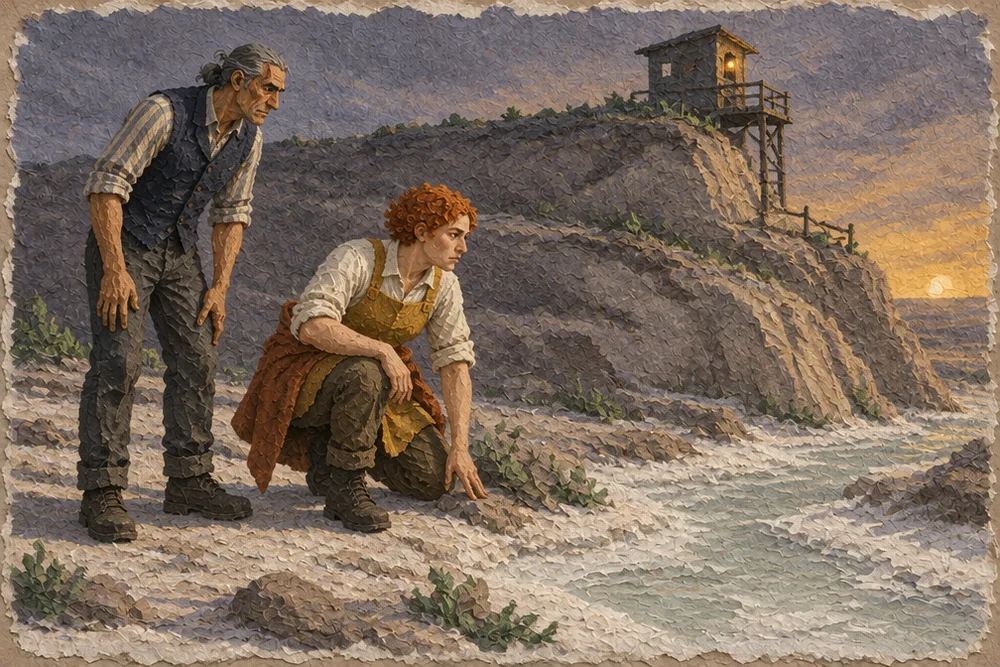
She lowered the lamp without lighting it. “We’ll have time for the cart if they’re close.”
“If they’re close,” Vasko echoed, and looked toward the road as if he might summon it by inspecting the empty distance.
A cart bell rang once, faint and uneven. Tamar moved down from the shelf, looking past the launch toward the road’s bend. The bell rang again. Then the sound cut off.
“They’re at the dip,” she said.
Vasko picked up the long-handled winch bar. “Could be just the cart axle.”
“Could be.” She crossed the yard at a fast walk, leaning forward from the ankles. The road dropped out of view beyond a shoulder of salt-crusted stone. She reached the top of the incline and saw the nursery cart on the far side, no more than fifty paces away. Its two narrow wheels stood in a skin of water. The driver had turned the animal uphill; its hooves struck and slid on the wet track. The cart’s canvas hood, tied down around its cargo, shone dark with spray.