The Saltwind Switchback
Page 173 of 175
Chapters
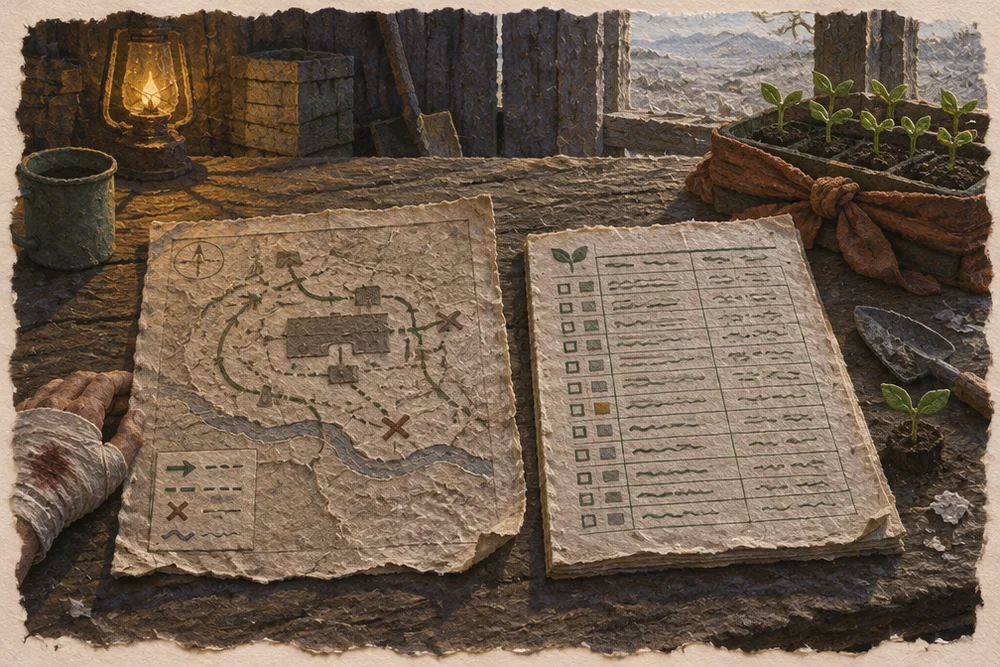
The route archive clerk arrived with a bundle of old maps. He spread them over the table in the shed: production lines in black ink, evacuation marks in faded amber, a newer survey in chalk-blue pencil. Tamar turned each one carefully. The old diagram that had saved her on the night of the flood showed safe places, not promises. It had preserved the order of the refuges but not their condition. The newer register now carried both their history and the tests that would keep it current.
“I’ve made a copy for the nursery,” Nemi said. “They need to know where the line stops, not just where it goes.”
“And one for the launch,” Vasko said. “The next tender can’t learn by looking at the wrong map.”
Tamar studied the faded evacuation marks. In one corner, a small X stood beside a ledge that the quarry survey had labeled useless. The old crews had known something the production map never needed to tell: a person could wait there while the canyon changed its mind.
She copied the X into the new register and labeled it refuge, then added the old name from the diagram beside it. It seemed important that the marks not be translated into something too clean. A place did not become useful because a new worker had given it a tidy title. It had been useful before anyone wrote it down.
“You kept the evacuation diagram,” Vasko said.
“I did.”
“After you chose the fast line.”
“Yes.” Tamar closed the map. “I thought it was a record of where people had gone. I hadn’t understood it was a record of what they had judged worth reaching.”
Vasko’s gaze settled on the inked X. His face was triangular and spare, the heavy lower lip set in its familiar line. “We used to mark places where a person could put both feet down and wait. There’s no glory in it, so the production maps left them off.”
“Not this one,” Tamar said.
She wrote the date beside the mark. Then, below it, she wrote the conditions under which it could be used and the people responsible for checking it. The ledger’s pages had begun as a list of obligations. They were becoming a record of shared choices: what had held, what had failed, and who had the right to stop before failure turned into loss.