The Saltwind Switchback
Page 122 of 175
Chapters
The tray was behind her, still at the saddle. She had told herself that the worst was past once she had found the split pillar’s pocket. The thought had been less a judgment than a bargain with fear. Now the old route beneath her was a white slope veined with dark water, and the new route depended on a rock that was coming apart from the bottom.
She hooked one arm through the basket’s side rail. Her long reach made it possible to catch the frame without leaning out over the cable, but the effort pulled her rust coat tight across the shoulders. The basket swung once toward her, then away. Tamar pressed its rim to the ledge and set the brake with her knee.
The small iron ratchet bit. Its teeth were worn rounded, and the handle jumped in her glove before it locked. She tested it once, slowly. The basket stayed put. She could not leave it there long. The surge had come higher each time, and the water’s surface had begun to carry pale flakes from the pillar’s skirt.
She looked for Nemi’s lamp. The terrace notch lay beyond the eastern shoulder, past a bend in the canyon. A dim amber dot showed for an instant through the salt haze, then vanished behind the rock. Tamar waited, keeping her face turned toward the gap. Nothing answered.
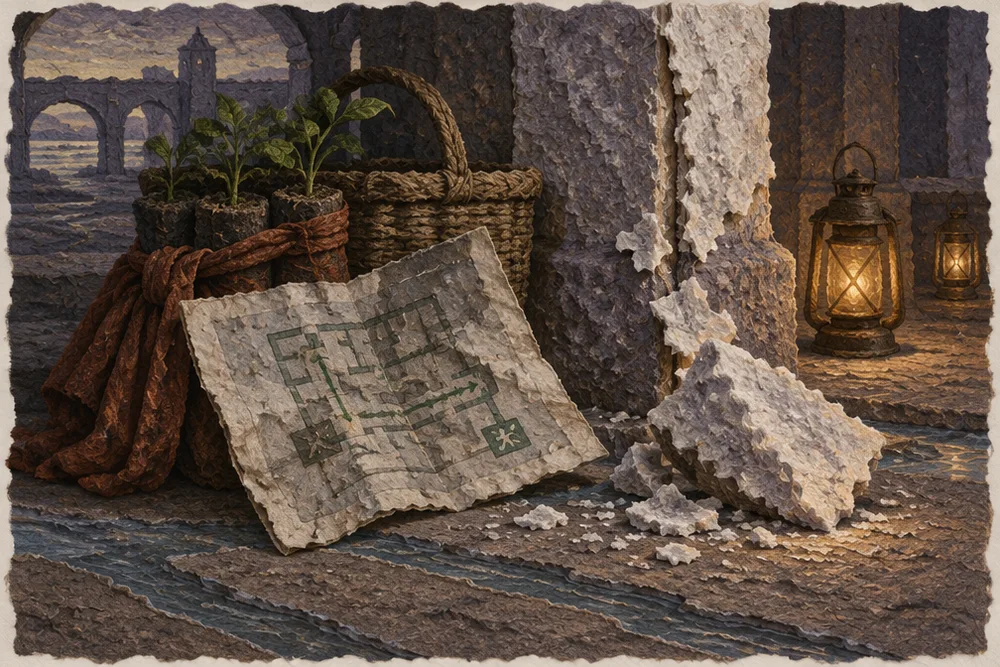
Nemi had made the upper notch signal clear: a shutter opened twice, then held. It had meant room for a handoff, not a promise that the route was safe. Tamar could not make out whether the lamp had moved or the haze had thickened. The distance between the two was only a few hundred yards in a straight line, but the canyon bent around its own walls, and the air was filling with brine mist.
She took the folded evacuation diagram from her coat and opened it against the basket’s side. The paper had softened along its creases. The faded marks were simple: a return spur, the high saddle, then the two old spans turning east around the split pillar. The route had been drawn for people leaving in a hurry. Its safe standing marks were little crosshatches, not the squares that marked freight fixtures on the production map.
The saddle was still behind her, but the first span between it and the pillar had not been designed to carry a person climbing along the exposed face. She had crossed it by basket because that was what she knew how to judge: load, swing, tension. A traverse meant trusting footholds she could not yet see and reading stone under her hands instead of steel under her boots.