The Noon Fold of Gannet District
Page 83 of 216
Chapters
“Water,” she said.
Mera held the cord taut. “How far below?”
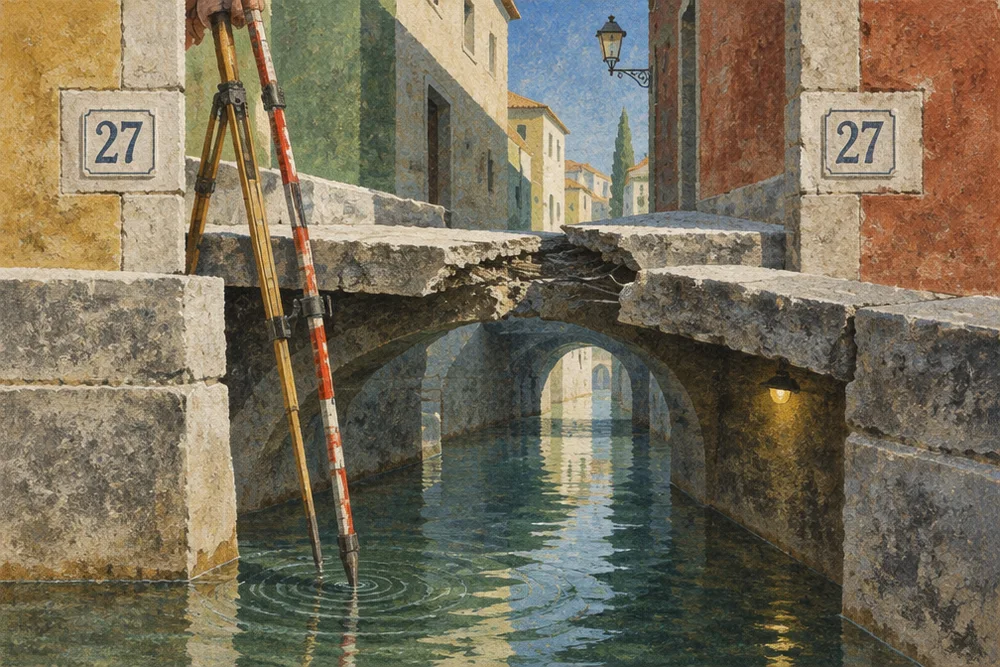
“Not far enough to tell from here.” Avel marked the cord with chalk at the point where the staff disappeared, then drew it back. A smear of clear water ran along the metal. It looked no different from the water in any street drain. That was the trouble: the seam was not a void in the ordinary sense. It had a level, a pressure, and a cold draft from somewhere beneath the city.
They moved to the opposite side of the broken route by circling through the school and climbing the uphill municipal passage. The passage aligned with the outer face now, though it had not done so in the morning. Avel watched the address plates as they went. Every plate matched its counterpart across the fold, white lettering against dark iron, fixed at the same height. The walls changed angle around them; the numbers did not.
At the outer approach, they found the same shadowed break from the other side. Avel tied the cord to a bolt in the crane footing and lowered the staff again. It struck water at almost the same depth. Almost. The difference was less than the staff’s marked interval.
Mera stared into the gap. “So the street is gone, but there’s water under both ends.”
“Open water, or a channel,” Avel said. “I can’t tell which.”
“Can a boat reach it?”
Avel considered the slanted walls, the twisted paving, the unseen current. “Not safely. And even if it could, we have no continuous bank to land on.”
Mera lifted the cord and inspected the wet chalk. “Then write that. Not ‘possible crossing.’ Not ‘access uncertain.’ Write that neither end reaches the other.”
Avel did. She added the matching depths and the time of the test. The report seemed too small for the gap it described. Her pencil point snapped on the final figure, leaving a black fleck beside the word unreachable.
Across the seam, the outer road creaked as the fold continued to settle. The building faces held their addresses. The street between those addresses had become a dark, water-sounded distance that belonged to neither route.
Mera was already thinking of the people who had lived nearest the missing street. She called the names from her list, pausing after each one for an answer. A few residents responded from the school terrace. Others were farther uphill, gathered by the laundry. The household they had brought out was there, seated on a folded blanket with the child asleep across the man’s knees. The cat had escaped its coat and was washing one paw.