The Noon Fold of Gannet District
Page 29 of 216
Chapters
Tern leaned close without touching it. “You can’t isolate a dry line.”
“Then the test will show dry.”
“And if it doesn’t?”
“You’ll have witnessed that too.”
Tern’s eyes narrowed. The pump hall smelled of wet iron and old rope. On the wall, a charcoal diagram showed the trunk passing beneath the waterfront, its route ending in a thick cross. Someone had written DRY in white chalk beside the mark, then underlined it several times.
Avel unrolled the map. “The fold begins in eleven minutes. I need a reading here, then one at the matching address across the crease. Same duration, same measure.”
“You want me to put my name on a number that council will call a trick.”
“I want you to put your name on what the gauge does.”
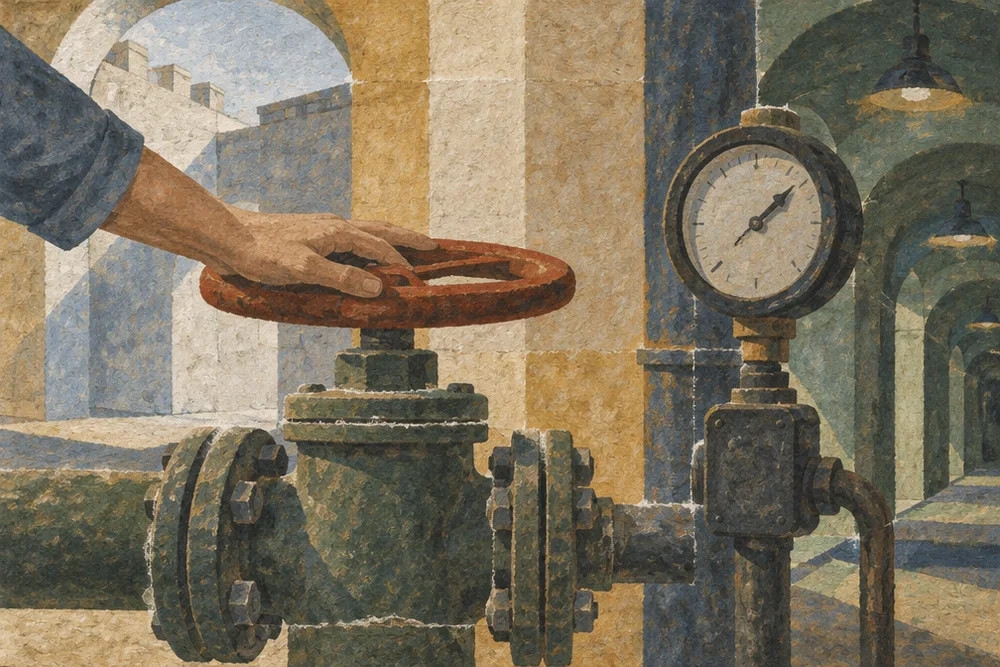
For a moment Tern considered her. Then he reached for the lower cabinet and found the small brass key on a hook. “One cup,” he said. “Not a bucket. I’m not giving them an excuse to say I drained the reserve.”
They closed the street feed and turned the emergency branch. Avel fitted the meter between two threaded joints, using a strip of oiled cloth to stop the leak at the coupling. Tern checked the clamps with his thumb, then put one hand on the wheel. Avel raised her watch. The pump hall’s only window framed a slice of noon sky, pale as tin.
“On three,” Avel said. “One. Two. Three.”
Tern opened the valve a finger’s width. The meter clicked. Its needle crept forward, steady and small. Avel marked the start reading and the seconds in her notebook. Tern watched the gauge above the pipe. The line was not dry.
They held the draw for exactly one minute. The needle advanced by four tenths of a unit; the hall gauge dipped and returned when Tern shut the branch. He signed Avel’s notebook beneath the figure, pressing hard enough to score the sheet below.
“That’s an ordinary bleed,” Tern said. “A bad seat in a joint.”
“Could be.” Avel tore no paper and argued no further. She had learned that a number became less useful when someone felt obliged to defend it. “Now we repeat across the crease.”
The warning bell rang once as they left. Along the seawall, workers stopped hauling timber. Yellow pennants lifted in the wind. Avel crossed to the address plate for Bell Court, fixed to a low wall beside the pump hall. Its enamel letters were worn at the edges, but the number remained plain: 18.