The Noon Fold of Gannet District
Page 175 of 216
Chapters
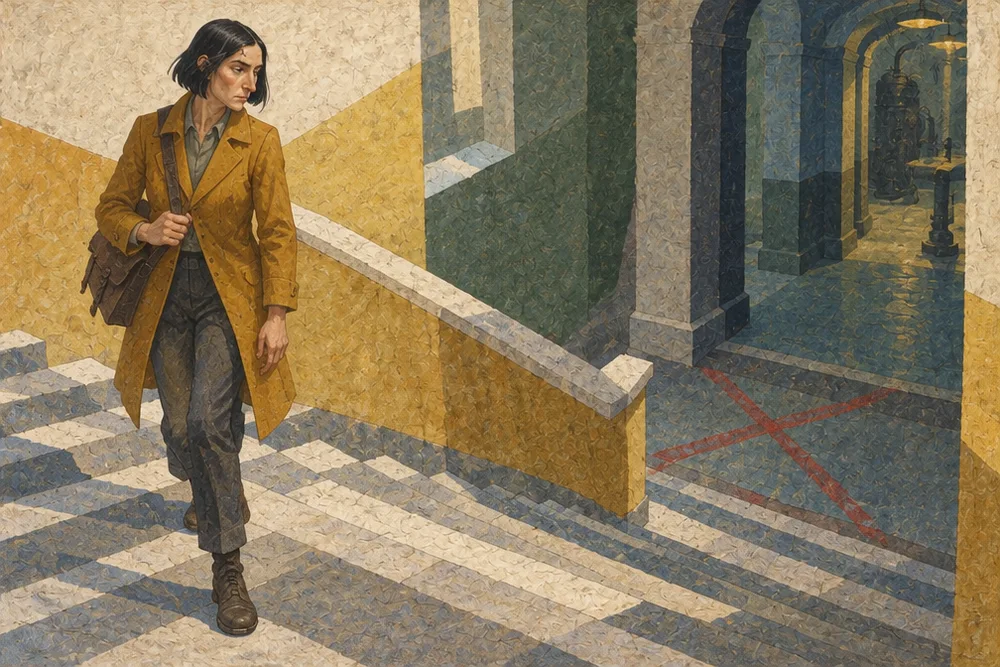
A route to the Outer council chamber ran through the old school stair, down past the pump hall, and across the aligned waterfront. Avel had used it enough to know each landing by its address plate. But the first flight no longer met the second cleanly. A hairline of daylight showed between two stone steps, thin as a pencil mark. Avel crouched and ran a ruler across the seam. The upper stair had shifted outward by a fraction, enough to catch a toe if someone descended in a hurry. The address plate, bolted to the wall, still read Bell Court, 8. The landing beneath it seemed to slope away from the stairs. Avel looked back at Mera. “We should close this route.” “It is how the families are moving to the rooms.” “Then we need a watcher at each end, and no one on the damaged flight without a hand on the rail.” Mera called to the pupil, who ran to fetch two adults. Avel marked the bad step with a red chalk slash. The mark would tell the next person where to slow down; it would not repair the stair. There was a lesson in that difference, and Avel was tired of learning it only after someone had been hurt.
The fold announced itself without the warning bell. A low knock travelled through the masonry, followed by the faint metallic complaint of a water main under strain. Every head in the stairwell turned toward the waterfront. Avel’s case gave a single tremor against the hip. The meter inside answered with a pulse that could be felt through its padding. “That is early,” said one of the adults. “Yes,” Avel said. There was no benefit in softening it. The stair began to slip out of alignment by visible increments. Avel watched the seam widen, then dragged the red chalk across the landing to mark a boundary no one was to cross. The children had been moved to the uphill rooms before the shift began, but some residents remained in Bell Court to gather bedding and household goods. Mera’s helpers called from the lower corridor, directing them away from the damaged flight. One woman came up with a folded mattress balanced over her head. An older boy carried a metal pot by its handle. Avel held the door while they passed, waiting until their feet reached the safer landing before taking the stairs down. Each step had to be tested. One held. The next rocked. Avel kept a hand on the rail and descended sideways, with the case braced against the chest. The stair’s familiar geometry had become a negotiation: boot, tread, rail, next plate. No straight line could be trusted.