The Noon Fold of Gannet District
Page 163 of 216
Chapters
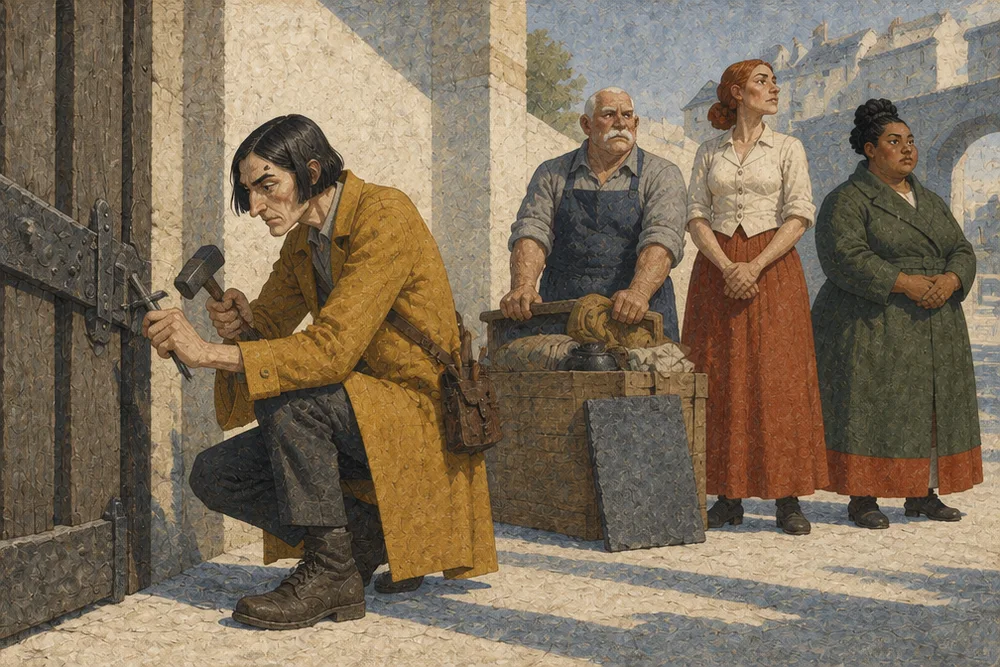
She added the gate to the plan and measured from its sill to the path. The missing line changed the evacuation route; it also changed who could certify it. Avel asked the tenant to mark the location in his own hand. He wrote the nearest cabin number, then drew an arrow.
“That’s not where it is,” he said, looking at her first mark. “You’ve put it beside the lane.”
Avel erased the mark. “You’re right. Show me again.”
They began with the Inner Gannet row. A ring of borrowed keys passed from hand to hand, and Mera’s list went with it. Each cabin had a low ceiling, a plank door, and a number painted in white on a slate-blue board. Some rooms were bare except for a mattress. Others held pots, folded clothes, jars of screws, or small objects arranged on shelves as if their owners had stepped out for an errand.
Avel asked the same questions at every door: Who had slept here last? Where had they gone? Who could verify it? The tenants knew the answers. The lease ledger did not.
In Cabin Four, a girl’s school slate lay beneath the bed. Avel lifted it by one corner. Names and sums filled one side; on the other, a ship had been drawn in chalk, its hull unfinished.
“She’s my niece,” said the woman who had moved to the municipal rooms. “She’ll want that.”
Avel set the slate on the table rather than putting it on the pile of abandoned objects. “We’ll carry it with the household things.”
The woman nodded and made her check on the roll. Her signature crossed the line without hiding the name. Mera had brought a shallow crate for items people needed carried uphill; the slate went in beside a folded blanket and a tin of sewing needles.
At the end of the row, the key ring lacked one key. A tenant tried the latch with a bent iron hook. It lifted, and the door swung inward. A narrow bed, a stove, a bowl of clear water covered by a saucer.
“That’s Jori’s,” the tenant said. “He’s already moved. I carried the stove with him.”
Avel kept the entry open until another pair returned from the uphill rooms and confirmed Jori’s new place. The roll had room for both facts: the room was empty; the person had moved. She wrote the room number, then let the tenant who had carried the stove check it against the address painted on the door.