The Noon Fold of Gannet District
Page 116 of 216
Chapters
“I’m not printing an accusation,” Avel told him. “I’m printing measurements.”
“That distinction has kept the office peaceful for generations,” the operator said.
“Then you’ll appreciate it.”
Avel spread the papers in order. First came the reading from the meter while it rested under Bell Court’s washbasin. Next, the second signed reading from the outer pump test. Then the schedule showing the outer development’s planned flushing draw, its date, and the permit number authorizing the tower connection. She added the inner housing approvals, where the new connections were counted by occupied rooms rather than titles. Last came the old survey sheet that marked Bell Court’s surviving school as vacant, signed in Avel’s own hand.
The press operator read the sheet twice. “You’re putting your own error in the middle.”
“It belongs in the middle.”
She placed a typed note beneath it: THE VACANCY FINDING WAS WRONG. BELL COURT WAS OCCUPIED. MY SURVEY WAS USED IN PERMIT FORECASTS. The words looked harsh in black ink. Avel had chosen them carefully. No passive phrasing to hide behind, no claim that an old map had made itself.
Tern stood over her shoulder, arms folded. “Good. Now show the dates.”
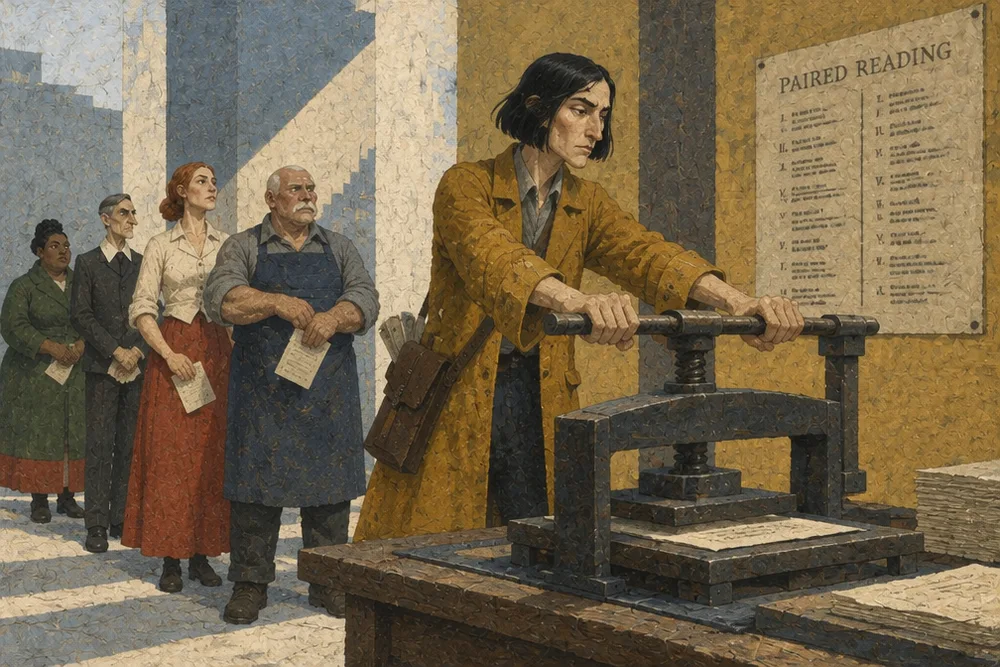
They printed a broad sheet with columns: date; permitted connection; recorded draw; source; signature. The paired readings occupied the same line. One was marked INNER—BELL COURT WASHBASIN. The other was marked OUTER—PUMP TEST. Beneath them, the meter serial appeared in thick type. Along the bottom, the two council seals sat beside their separate forecasts. Each forecast assumed the other district’s future demand would be zero.
The first pull came away smudged. Avel rubbed a thumb over the heading and saw the letters blur. She adjusted the press, changed the pressure, and tried again. The next sheet was clean enough to read from arm’s length.
The operator pinned it to the wall. A bondholder at the end of the queue leaned toward it. Then another did. They did not crowd the page; they stood back, reading the dates before they read the accusation.
“How many?” Tern asked.
“As many as the paper holds,” the operator said. He put another stack beside the press.
Avel set the meter at the center of the counter, where it could be seen, and started the next run.
By the time Avel and Tern left the assessment office, the warning bell had stopped. The street remained level, but the air had the waiting feel that came just before a crossing. They carried copies in a flat crate. People along the bondholders’ queue had taken the first sheets, holding them against coats or folding them into document cases. One woman had used a clean corner to compare the permit date with the date on her bond certificate.