The Noon Fold of Gannet District
Page 100 of 216
Chapters
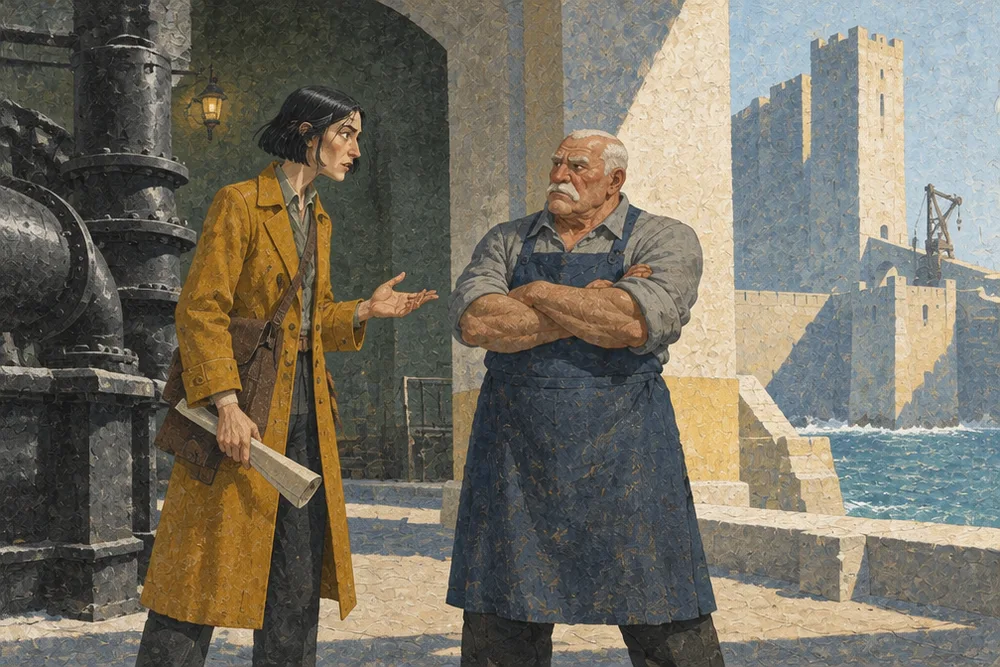
The corridor was crowded with the things a school had not been built to keep: rolled bedding, baskets, a handcart with one crooked wheel. The inner classrooms had become sleeping rooms. On a blackboard, beneath a child’s half-erased sums, Mera had written a water schedule in chalk. Avel read the times as she passed. Cooking had been moved to the hours when the kitchen was quietest; washing was done by basin. There was no room in the schedule for a new supply.
“Then they can stand on opposite sides,” Avel said. “The valve is between them.”
Mera glanced toward the kitchen. A child was holding a cup under a tap, counting drops aloud. The count broke when the pipe gave a dry cough. “And if they leave without opening it?”
Avel had no answer that would fit in a report. She looked at the gauge again, fixed its reading in memory, and set off for the waterfront with Mera beside her. In her coat, the calculations pressed against her ribs with each step.
The noon crossing had become less a crossing than a negotiation with the street. At the warning bell, the slate waterfront lifted along its familiar crease. Avel kept one hand against the wall and read the address plates as they tipped into alignment: Bell Court, 18; Bell Court, 20. The numbers matched across both faces, but the curb between them rose at an angle steep enough to require a careful climb. Below, the seawall’s shadow widened. Above it, Outer Gannet’s new tower foundations stood in orderly squares, their reinforcing rods black against the glare.
The bell sounded once from somewhere uphill, then rang again, its second note seeming to come from the opposite side of the street. People stopped where they were. A handcart rattled against a kerb and settled at a new angle. No one hurried toward the aligned plates. They had learned that the numbers stayed trustworthy longer than the ground did.
Avel had crossed this route many times since the fold began. She no longer tried to judge how far one place was from another by sight. A familiar curb could rise into a climb, a doorway could draw close while the street between it and her lengthened, and a shallow gutter could become a step. The address plates held their level on the walls. She followed them, not the distances.
The tower foundations made a severe geometry against the white noon. Their survey stakes had not moved, though the slate around them tilted. Each square was meant to support a building that would add new connections to the trunk. Avel had read the permit forecasts: projected occupants, projected consumption, projected revenue. The word projected had done more work than any of the numbers. Her corrections had arrived after the bonds were issued.