When the Stairwell Forgets You
Page 50 of 265
Chapters
Reva studied her, as if deciding whether the words had any weight. “Go do whatever you do when you’re worried.”
“I don’t know what you mean.”
“You clean something. You check a list. You put a key somewhere safe and forget why you have it.”
Verity’s hand went reflexively to the ring at her hip. The unmarked brass key pressed against the other keys. She did not remember why she carried it. Reva noticed the movement but did not ask.
“I’m going to get the lease,” Verity said.
“After my shift.”
“After your shift.”
Reva closed the door. It did not slam. The latch clicked, a small sound with a definite end.
Verity stood in the corridor for a few seconds. She had spent most of her life making a passage smooth before anyone could stumble. This time, she had been told to wait at a door. She tried to let that be an instruction instead of an insult.
At the stairwell, Verity took out her notebook and read the two names. Ivo Hext. Una Cray. One had vanished from his own flat after answering a voice from beneath the landing. The other had left a skirt hem caught behind a wardrobe, and a blank where her surrender ought to be. Verity did not know whether the two losses had the same cause. She knew only that the building had made both of them easy to misplace.
The inspection would continue in the afternoon. Nell had postponed the occupancy portion, not the whole renewal. Her clear document wallet and plum rain shell would return to the block. A witness from outside, the old note had said. Verity had not yet decided how much to tell Nell before the roll began. She had promised every door was accounted for. She could still keep the promise by narrowing what she counted, by calling an occupied flat settled and a missing tenant past.
That was the kind of neatness that had brought Reva here without a question about Una. It had also left Ivo’s chair warm and his name loose in Verity’s mouth.
She climbed to the top floor, checking the landing lights as she went. The square glare from the windows fell hard against the cream walls. At each door she saw practical signs of life: a pair of boots placed heel to wall, a grocery bag folded beneath a bench, a damp towel hung from a radiator. These were not accounts of who had a right to stay. They were evidence that somebody depended on the rooms.
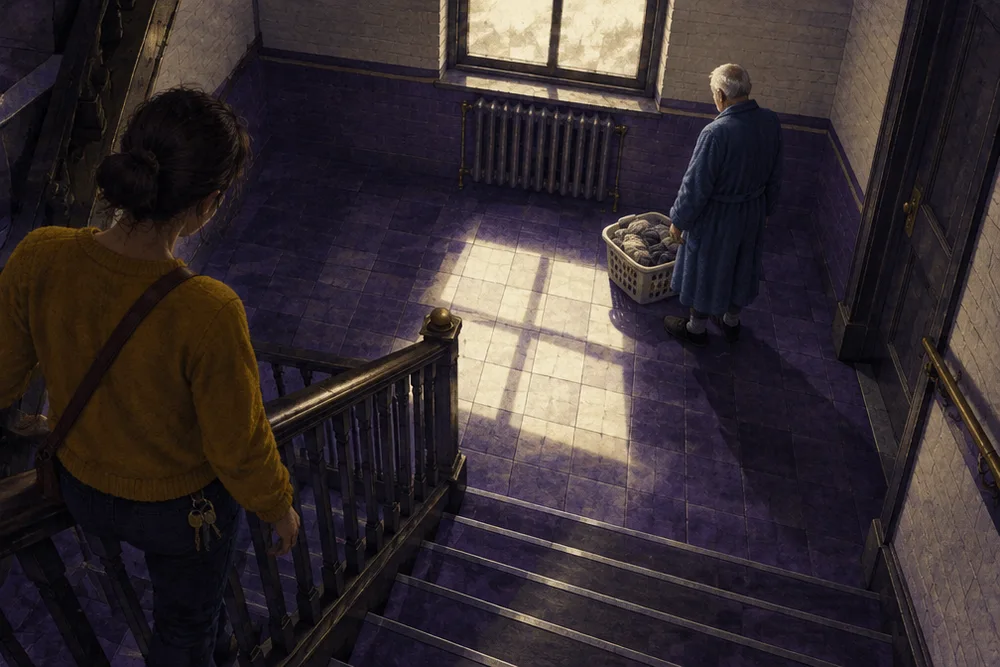
On the second-floor landing, an old man in a blue dressing gown waited beside a laundry basket. He glanced at the ring of keys. “You still fixing the cellar lock?”