The Moon in the Fitted Sheet
Page 83 of 303
Chapters
Linio set the frame beside the retired linen. The two fabrics looked almost identical until he angled the counter light across them. Then the marbling showed: faint milk-blue swirls in the family sheet, gray-white streaks in the old one. The pattern gathered at certain points, where a seam curled around a small woven mark. Linio brought over a magnifier and held it between them.
“Those little knots,” Elva said. “They’re repeated.”
“Every few meters.” Linio turned the retired sheet so its seam ran straight along the counter. “Could be a loom reference. Could be a repair marker. If the perimeter was divided into lengths, each length would have a station household’s linen attached to it.”
“That would mean everyone’s sheets—”
“Not everyone’s. The builders distributed the fold through domestic linen and public stock. A lot of it was replaced over generations. Maybe the household marks tell us where.” He rubbed one of the knots with his thumb. “This part is older than the station’s current inventory system.”
Elva looked down at the family sheet’s familiar corner. A small white tag was sewn beside the loop. She had always thought it was a maker’s label, its characters faded nearly blank. Now she saw the same knotted stitch beneath it, almost hidden by the tag’s edge. “Our sheet has one.”
Linio glanced at her. “Then we start there.”
He found a narrow table and cleared off a stack of folded pillowcases. Elva helped him lay out the retired sheet, easing each section flat without pulling. They did not wash or wet it. The counter’s rinse cycle stood within arm’s reach, a shining steel drum with a green start switch. Elva kept her body between it and the frame. Neither of them had forgotten what a wash would do.
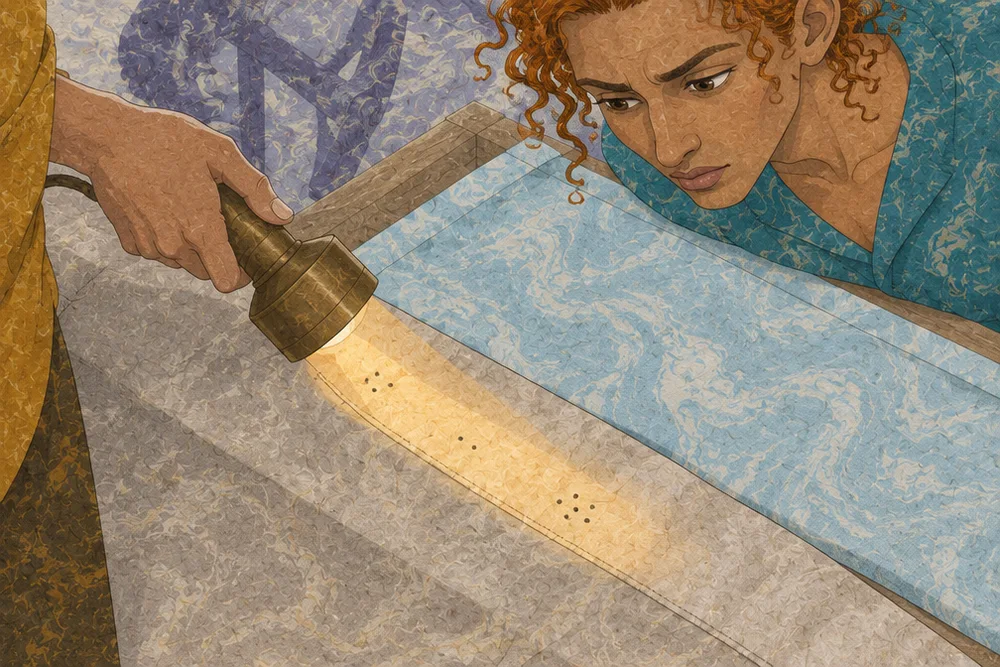
Linio fetched a hand lamp from the maintenance drawer. Its beam was amber and sharp, meant for finding snags in fabric before a sheet entered the loop. He passed it to Elva. “Try along the stitch line. Don’t put the beam through the opening.”
She moved the light slowly over the old hem. Where the fabric had been folded and resewn, tiny pinpricks shone through. They made uneven clusters: three, then two, then five. Elva counted them twice. The clusters were not random. Between them, the thread changed color or direction, as if different hands had repaired the same border at different times.
“Could be locations,” she said.
Linio lowered his face toward the sheet. His copper coils brushed the counter edge. “Maybe. Let’s see if the pattern holds.”