The Moon in the Fitted Sheet
Page 46 of 303
Chapters
Elva looked at the label again. “You kept them.” “I kept meaning to.” Hesta’s eyes stayed on the parcels. “Every year I thought I’d have the right words by the next one. Then the next one came.” Her voice did not ask Elva to answer. The parcels occupied the floor between them like a small, patient audience. The dates on their labels spanned years Elva had known only as her aunt’s absence: Iona gone from the station, Hesta still young enough to think time might be held to a promise.
Elva gathered the fallen things, placing them back in the bag one at a time. She set the parcels aside rather than pushing them into the packed interior. “Do you want me to take these?” Hesta looked at her, eyes deep-lidded and tired. “No. I’ll carry them.” Elva nodded. She lifted the bag by its strap and waited for Hesta to decide when to stand.
Hesta pressed her palm against the rail and rose in stages. First she brought her weight over the good leg, then she straightened her back, then tested the stiff knee with a cautious shift. Elva kept the bag within reach but did not offer to carry it. The parcels had been placed back inside, though the oldest one sat at the top, its cloth-repaired seam visible through the unzipped mouth. Hesta noticed Elva noticing it and zipped the bag closed.
“We can stop at the clinic,” Elva said. “If you want.” “I want to sit down at home.” “That’s not the same as saying you’re fine.” “I didn’t say I was fine.” Hesta’s gaze remained level. The exchange left a brief silence, but it was not empty. Elva had spent years treating preparedness as a way to keep anything bad from happening. She had learned to pack extra, check seals twice, make the bed before anyone asked. The moon in her apartment had not cared about any of that. Neither, apparently, did her mother’s knee.
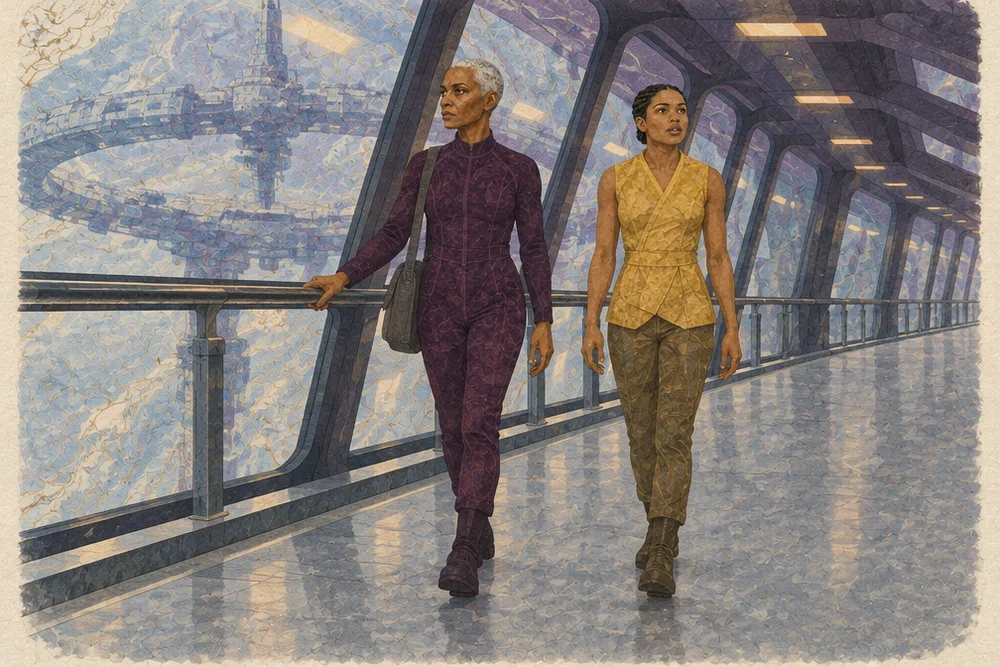
They continued along the gallery. This time Hesta chose the rail at every turn and kept her steps shorter. Elva walked beside her, not behind, leaving a hand’s breadth between their sleeves. The windows along the passage showed the station’s inner structure: ribs of dark metal, lamps set in service channels, and the distant ring where cargo locks sat dormant. No true stars were visible from this stretch, only the station’s own lights reflected in thick glass.